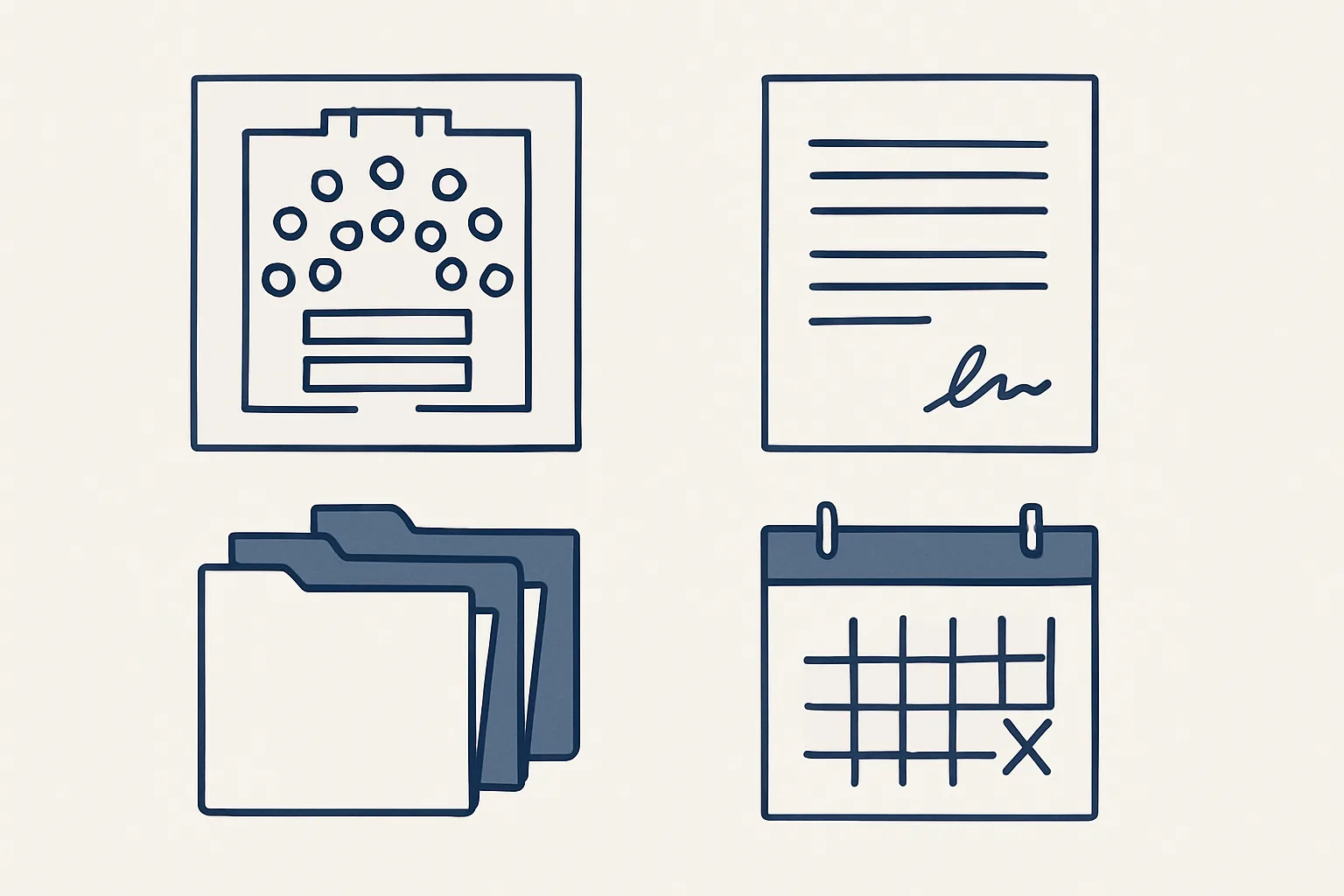
AI for event planners takes the admin around each event: contracts sent as signable pages, supplier papers and bills kept in order, enquiries followed up with drafts, and final invoices prepared. You check and send everything, and stay free for the event itself.
What is the admin behind every event?
AI for event planners is for the part of the job nobody sees: the paperwork around the day itself.
Picture a wedding planner with six events in the diary. Each one has an enquiry, a contract, a deposit, a dozen suppliers, a pile of changes and a final bill. Most of it lives in email. The event is fun. The admin is what keeps you up at night.
AI can take most of the reading and typing off your plate, as long as it stays in its lane. It prepares the work and the registers. You approve it at the start, and payments stay with you.
Think of the days before the event. The venue calls, a supplier changes a time, a client adds guests. The paperwork has to keep up with all of it.
We go through the admin in the order it usually happens, from the first enquiry to the final invoice.
How do enquiry follow-ups work?
Each enquiry is logged in one place, and a first reply and later follow-ups are drafted for you. Nothing slips because someone was busy on site.
Say a couple emails about a September wedding on a Tuesday while you're at a venue. Without a register, the reply waits until Thursday, and they've written to two other planners. With one, a draft reply is ready that evening.
Lead follow up automation of this kind covers incoming enquiries only. No cold outreach, no bought lists. It's built to order, and it isn't running for a client yet. Here is the route:
- An enquiry arrives by email or from your website form.
- The robot logs it on the enquiry register with the date, event type and any details given.
- It prepares a draft first reply from your own past answers and your current packages.
- You read the draft, edit it and send it.
- When a follow-up is due and nobody has replied, a draft follow-up is put in front of you.
- You send it, change it or close the enquiry, and the register shows the outcome.
How are client contracts signed online?
Each contract becomes a private page with its own link. The client signs with a drawn signature, a typed name and a consent line, and a certificate records who signed and when.
This is running today. We built the signing page ourselves, so there's no outside service in the middle. The signed copy and the certificate go into the client's folder together.
Online contract signing suits event contracts well, because clients are busy and often on their phones. A couple on a train can sign in two minutes.
Everyone signs on their own time. You see who has signed and who hasn't, and a gentle reminder is one tap away.
For a rule of thumb: whether an electronic signature is enough for a given contract depends on your country, so check with your adviser.
How do supplier papers and bills stay in order?
Every supplier has a record with the papers you need: company details, bank details and insurance. Their invoices are read and entered as draft bills.
Think of a florist, a caterer, a sound company and a photographer on one wedding. Four suppliers, four sets of papers, four invoices. In a spreadsheet and a mailbox, that's easy to muddle.
An onboarding step for suppliers requests the papers by draft email, collects them, checks what's missing or out of date and files them with a row on the register. That's supplier onboarding done once, at the start. It's built to order.
Their invoices then follow the supplier bills route, running today for a client. A person approves a new supplier before anyone pays them. Here's the picture:
| Admin task | What the robot prepares | Who acts | Status |
|---|---|---|---|
| Enquiry follow-up | Register row, draft reply, draft follow-ups | You send | Built to order |
| Client contract | Private signing page, certificate, filed copy | Client signs | Running today |
| Supplier papers | Draft request, checklist, register row | You approve | Built to order |
| Supplier bills | Draft bill with the PDF, filed by supplier | You approve | Running today |
| Final invoice | Draft invoice and draft email | You send | Running today |
Your admin for one upcoming event
Think of one event on your calendar. Tick each item that's already done or clearly in hand, working back from the event date.
How are final invoices prepared?
The final invoice is drafted from the event record: the contract price, the agreed extras and the deposit already paid. You check and send it.
Extras are the usual trouble. 'Can we add a dessert table?' 'Can the band play an hour longer?' If these live in emails, they get missed. If they're written on the event record as they happen, the draft picks them up.
The invoicing route runs today for a client: a sheet that remembers clients and products, a ready check, tax wording applied, the PDF made and filed, a draft invoice in the accounts and a draft email.
Clients like it too. A clear final invoice with the extras listed rarely leads to an awkward call.
Say an event ends on Saturday. By Monday the final invoice is a draft on your screen. Not a month later.
What doesn't AI for event planners do?
It doesn't plan the event, choose the venue or talk to the client. Those are your craft.
It never pays anyone. It doesn't decide what to charge. It doesn't send a contract on its own.
Our rule is simple: every step starts with your approval, then you choose when it goes automatic. One command stops any robot.
What it takes off you:
- Retyping the same event details into several documents.
- Hunting for the signed contract.
- Chasing suppliers for the same papers.
- Remembering which supplier sent which bill.
- Building the final invoice from scattered emails.
How do you get started?
Start with one piece. Many planners begin with contracts signed online, since it's running today and the benefit shows quickly.
A good first month: run every new client contract through the signing page, check that the signed copies land in the right folders, then add supplier bills.
Don't wait for a quiet month. There isn't one. Start with the next contract.
Our AI employees are rented by the month and work with your own mailbox, folders and sheets. Your records stay in your accounts. If you stop, the workflow stops, and every document stays where it was filed.
Tick the list below with one upcoming event in mind.
Questions
What can AI do for an event planner?
It follows up on enquiries with drafts, sends contracts as signable pages, keeps supplier papers and bills in order and prepares final invoices.
Does it plan the event?
No. Planning, choosing venues and talking to clients stay with you.
Is it running today?
Online signing, supplier bills and invoicing run today for clients. Enquiry follow-up and supplier onboarding are built to order.
Does it pay my suppliers?
No. It never pays anyone.
Where are my files kept?
In your own folders, sheets and accounts. If you stop, they stay exactly where they are.
Tell us your workflow. We will build it around you.
Tell us how many events you run and how many hours the admin takes you each month. Write to [email protected] and we'll tell you plainly whether it fits.
Talk to us Related service: Contracts and signing