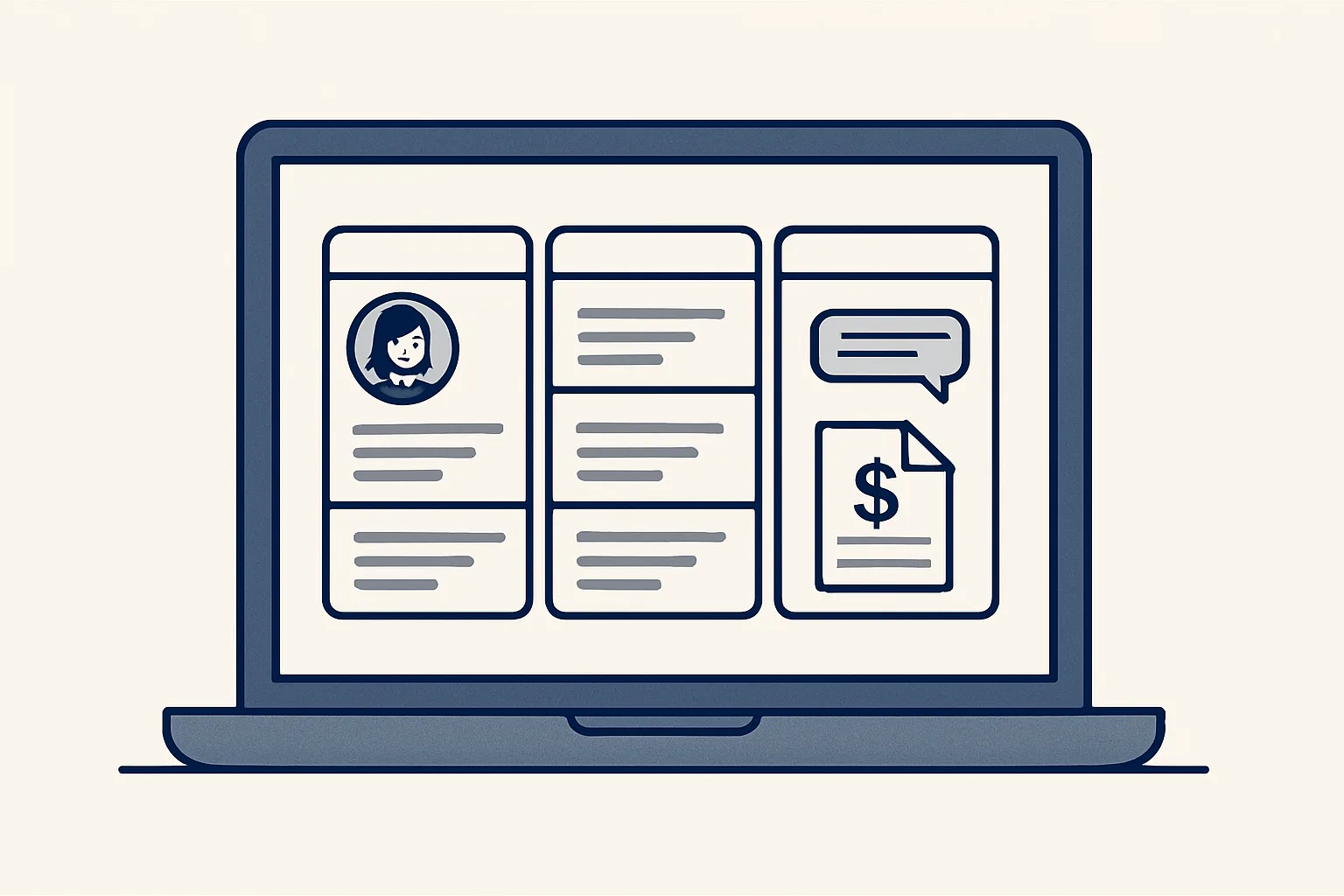
The most useful AI for marketing agencies takes on the admin around client work: approvals chased by email, briefs and meeting notes, invoices and supplier bills. A client portal with one space per task, plus drafted minutes and invoices, keeps that work moving while the team focuses on the work itself.
Where agency time leaks
Agency time leaks into the admin that surrounds every campaign, and that admin is where AI for marketing agencies is most dependable.
Most conversations about AI in agencies are about producing content: copy, images, ideas. That is a different subject, and not the one this article covers. The quieter cost sits around the creative work, in the hours spent finding the latest brief, chasing a client for approval, writing up a call, preparing the month's invoices and entering the bills from freelancers and media suppliers.
None of these tasks wins a client, yet all of them have to be done, often by the same people who should be doing the client work. They also repeat. Every client, every month, the same pattern: a kick-off, a few rounds of feedback, an approval, an invoice.
That repetition is what makes AI for marketing agencies practical on the admin side. A routine that happens the same way for every client can be written down once, and what can be written down can be drafted by a robot and checked by a person. Judgement calls, pitches and creative direction cannot, and are left alone.
The table below maps the usual leaks to what automation can prepare, and what stays with a person.
| Where time goes | What can be prepared automatically | What stays with a person |
|---|---|---|
| Feedback scattered across email | One task per deliverable with messages and files together | Answering the client and judging the feedback |
| Calls and meetings | Draft minutes, actions with owners and dates, draft follow-up emails | Checking the minutes and sending them |
| Monthly client invoices | Draft invoices from a sheet, PDF filed, draft email beside it | Approving and sending each invoice |
| Freelancer and media supplier bills | Draft bills entered with the PDF attached and filed | Approving and paying the bills |
| Contracts and statements of work | A private signing page and a signature record | Agreeing the terms with the client |
One space per task with each client
A client portal gives every deliverable its own space, so feedback, files and approvals stay together instead of spreading through inboxes.
Agencies feel the email problem more than most. A single campaign can produce dozens of messages across the client's marketing lead, their manager, your account manager and two designers. Each round of comments arrives in a different reply, and the latest version of a file is wherever someone last attached it.
With a client portal, each request or deliverable becomes a task. The conversation happens on the task, the files are attached to it and its status is visible: open, waiting for the client, waiting for the team, done. When a client asks where things stand, the answer is already on their page.
Our client app works this way and is running today. Each task has three spaces, for the AI, the client and the team. Mentioning a person by name sends a push to their phone, voice notes are transcribed and every message is also kept in the client's own spreadsheet. If you are comparing client portal software for an agency, check those same points: tasks, targeted notifications and where the record lives.
For AI for marketing agencies, the portal is also where automation shows its work. Drafted minutes, invoices and replies appear in the AI's space on the task, where the account manager can check them before anything reaches the client.
Meeting notes and actions
Drafted meeting notes turn a recorded client call into minutes, a list of actions with owners and dates, and follow-up emails ready to go.
Briefs often start life in a meeting. The client explains what they want, the team asks questions and everyone leaves with a slightly different memory of what was agreed. Writing it up properly takes time that rarely gets scheduled, so the brief ends up as a few bullet points in someone's notebook.
This service is offered and built to order. From a recording or notes that you provide, the robot drafts the minutes, pulls out the actions and prepares the follow-up email for the account manager. Only meetings the client agrees to record are used, and the notes are ready while the call is still fresh.
The result is a written brief that both sides have seen, attached to the task it belongs to in the portal. When feedback arrives later, there is something to measure it against.
Meeting write-ups are a good test of AI for marketing agencies because the result is easy to judge: the account manager reads the draft and knows at once whether it matches what was said.
Would a client portal help your agency?
Think of your three busiest clients. Tick each statement that is true of how you work with them today.
Invoices and supplier bills
Invoice automation prepares each month's client invoices and enters supplier bills as drafts, so billing day becomes a check rather than a typing session.
Billing is often the first place AI for marketing agencies pays back the time it takes to set up, because the rules are already written down in your rate card and contracts.
Agency billing is rarely simple. Retainers, project fees, media rebilled at cost and one-off extras all appear on different clients' invoices, and supplier bills arrive from freelancers, printers, platforms and production houses in every format imaginable.
Both sides are running today. On the sales side, the invoice is prepared from a sheet that remembers clients and the services you bill them for; the PDF is rendered and filed, a draft invoice waits in the accounting system and a draft email sits beside it. On the supplier side, bills and credit notes are read from the mailbox and a drop folder, entered as drafts with the PDF attached and filed under the supplier. Anything the robot cannot enter exactly, such as a refund or an unknown supplier, goes to a person instead of being guessed.
What this does not do is decide what to bill. Whether an extra round of changes is chargeable, or a media cost should be marked up, stays with the people who manage the client. For tax wording on cross-border invoices, check with your adviser.
Approvals and signatures
Approvals work best when each one has a single recorded place: on the task for creative work, and on a signing page for contracts.
Creative approval is a judgement only the client can make, and no automation should pretend otherwise. What a portal can do is make the approval unmistakable: the client marks the task done, or replies 'approved' on the task, and that moment is kept with the file it refers to.
Contracts and statements of work need a stronger record. Online contract signing is running today: the proposal becomes a private web page, each party signs with a drawn signature, a typed name and a consent line, and a certificate records who signed, when and a fingerprint of the exact document. Any later change shows.
Inside the agency, the same principle applies to everything the AI prepares: one recorded place for each approval. Every invoice, email, minute or proposal arrives complete, with its source beside it, so the team's check is quick.
That is the line AI for marketing agencies should hold: it prepares and records, and the people who own the client relationship decide.
Getting started
The simplest way to begin with AI for marketing agencies is to pick the one admin routine that costs the team the most hours each month, and to measure it by your own count before anything is built.
Agencies that get the most from automation tend to begin with a narrow, boring job rather than an ambitious one. A routine that is done the same way for every client gives the clearest test of whether drafting saves time once checking is included.
For many agencies that is billing; for others it is feedback rounds or meeting write-ups. Picking one keeps the first step small and makes the effect easy to see. Our AI employees are rented monthly, run on our servers and work inside the agency's own mailbox, folders, sheets and accounting system, so nothing moves to a system the team has to learn.
A sensible sequence looks like this:
- Running today: client app with task spaces, sales invoicing, supplier bills, online contract signing, daily mail digest.
- Offered, built to order: meeting minutes and actions, drafted client replies, onboarding paperwork for new clients.
- Not offered: writing marketing copy, designing ads or running campaigns.
- Take the self-check above to see where client communication loses time.
- List your admin routines and note how often each happens and how long it takes.
- Pick the one with the most hours and the clearest rules.
- Write down where the work arrives, what is done with it and who signs the result.
- Agree what the robot drafts and what always stays with a person.
- Switch on one routine, check its drafts for a few weeks, then decide on the next.
Questions
How can marketing agencies use AI beyond content?
On the admin: keeping client feedback and files on one task, drafting meeting minutes and follow-ups, preparing invoices and entering supplier bills. At the start you check and send everything; later you choose what goes automatic.
What should an agency look for in a client portal?
One task per deliverable, a page per client showing what is waiting for whom, notifications to the phone when someone is named, voice notes and files on the task, and a record you keep.
Can AI write our client invoices?
It can prepare them as drafts from a sheet that remembers clients and services, with the PDF filed and the email ready beside it, the same way every time.
Will clients accept AI-drafted meeting notes?
Clients see only what the account manager checks and sends. Meetings are recorded only with the client's agreement, and the notes are drafts until a person approves them.
Do you create marketing content or run ads?
No. We work on the admin around client work: communication, minutes, invoicing and bills. The creative work stays with the agency.
Tell us your workflow. We will build it around you.
Write to [email protected] with the admin routine that takes your agency the most hours each month, and we will tell you plainly whether an AI employee fits it.
Talk to us Related service: Client app

