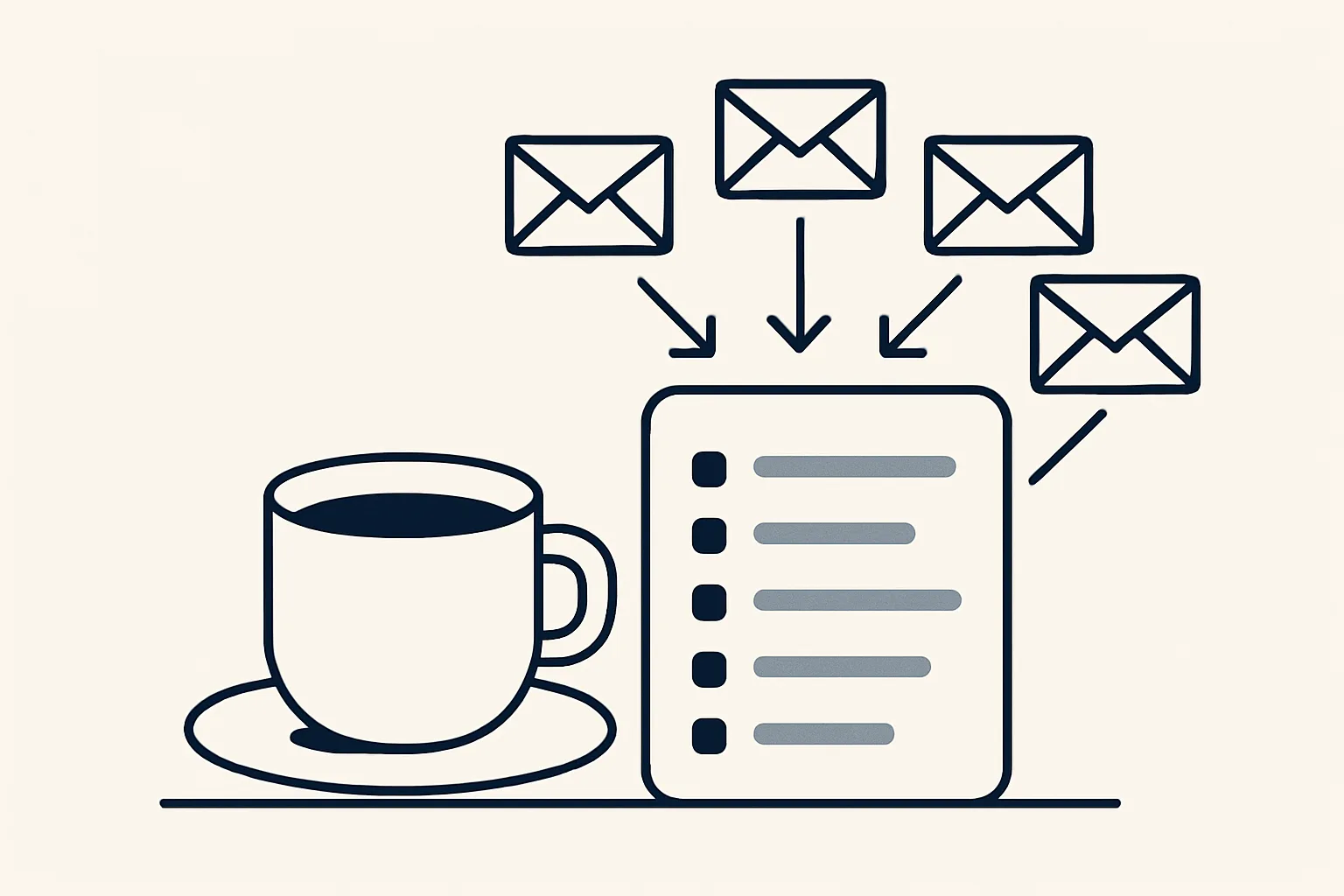
An AI powered executive assistant gives a busy owner one place to start the day: yesterday's new and unanswered emails across every mailbox, sorted by business, each with a one-line gist and the full text a tap away. It prepares; the owner decides and replies.
What an executive assistant does that AI can share
An AI powered executive assistant takes on the reading, sorting and summarising part of an assistant's job, while the judgement, the relationships and the replies stay with people.
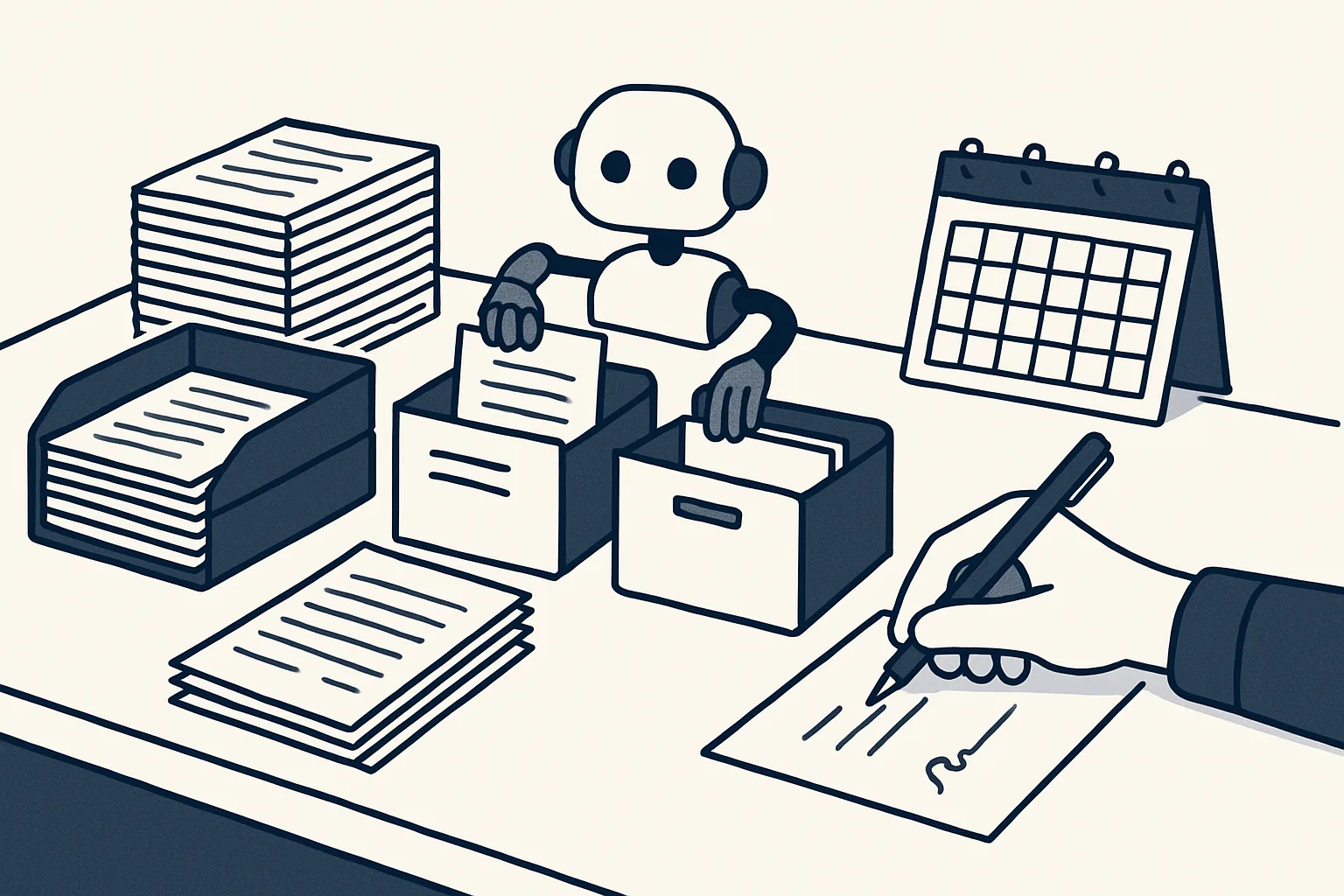
A good human executive assistant does many things: screens mail, keeps track of what is waiting, reminds the boss of deadlines, drafts replies, handles calls, manages the diary, smooths relationships and knows when to interrupt. Some of that is pure reading and sorting. Much of it is judgement built over years.
An AI executive assistant, as we build it, takes the first part: reading everything that arrived, sorting it, saying in a line what each item is about and putting it in front of the owner in one place. It does not handle calls, manage a calendar or book meetings, and it stops at the draft.
That narrower scope is deliberate. Reading and sorting are tasks where a mistake is cheap: an email placed under the wrong heading is still on the page. Sending a reply, accepting a meeting or committing to a deadline in someone's name is where a mistake costs real trust, so those stay with people.
The table separates the parts of the job that AI can prepare from the parts that stay with a person.
| Part of the job | AI can prepare | Stays with a person |
|---|---|---|
| Reading incoming mail | Reads everything new across all mailboxes | Deciding what matters most today |
| Sorting | Groups mail by business, sender and thread | Changing the rules when priorities change |
| Summarizing | A one-line gist per email, full text one tap away | Reading in full what needs it |
| Spotting what is waiting | Flags new and unanswered emails | Choosing what to answer and when |
| Replies | Draft replies, built to order | Every reply that is sent |
| Diary, calls, meetings | Not offered | The owner or a human assistant |
The morning brief
The morning brief is one page, ready at the start of the day, listing the previous day's new and unanswered emails, grouped and summarized, so the owner can see in minutes what needs them.
Our daily mail digest is running today. Every morning it gathers the previous day's new and unanswered emails across all the mailboxes of a group of companies, sorts them by business, gives each one a short gist and keeps the full text one tap away. Newsletters and login codes are filtered out.
The point is not to read less carefully. It is to read in the right order. An owner with several businesses and several mailboxes can open one page, see that a supplier is waiting on an answer in one company and a customer has asked a question in another, and start with those. Everything else can wait for its turn.
The gist is the part that saves the most time. A good gist says what the sender wants, not just what the email is about: a supplier asking to confirm a delivery date, a customer asking for a revised price, an accountant asking for a missing document. Read in a line, most emails can be put in order without opening them.
A typical brief contains a handful of fixed parts.
- One heading per business, in the order the owner chooses.
- Under each, the new emails from yesterday, each with sender, subject and a one-line gist.
- Emails still unanswered, marked so they stand out.
- The full text of each email, one tap away.
- Nothing from newsletters, notifications or login codes.
Across several mailboxes and businesses
An executive assistant is most useful to owners who run more than one business or more than one mailbox, because the brief brings them all into one view.
Owners of a group of small companies often have a mailbox per company, a shared sales mailbox, an accounts mailbox and a personal one. Checking each in turn is slow, and it is easy to miss the one message that mattered in the mailbox opened last.
The brief reads all of them and sorts by business, not by mailbox. Instead of opening each mailbox in turn, the owner reads one page with a heading per company, and the order of those headings is the owner's choice.
A related job also runs today: a mailbox watch that flags to the owner any email in a secondary mailbox that is not part of a known thread. It catches the message that arrives somewhere nobody looks often, without the owner having to check.
This matters most on busy mornings and after time away. Coming back from a few days off to several full mailboxes is the moment when important messages are most often missed. A brief that lists what is new and still unanswered, business by business, turns that backlog into a list that can be worked through in order.
What should your morning brief contain?
Tick each thing you would want on one page at the start of your day. The more you tick, the more a brief can take off your first hour.
Filtering noise: newsletters and codes
A useful brief leaves out the noise, such as newsletters, automatic notifications and login codes, so that what remains is mail a person actually needs to see.
In many business mailboxes, most new messages each morning were never meant to be answered: marketing emails, system notifications, shipping updates, password codes. They bury the handful of emails that need the owner.
Filtering them out is simple in principle and fiddly in practice. Some senders mix newsletters with real messages; some notifications carry real information. A good filter starts cautious, lets doubtful items through, and is tightened as the owner sees what slips past. Nothing is deleted; filtered mail stays in the mailbox as before.
Getting this right is most of what separates a brief that is read from one that is ignored. A brief that lists everything is just another inbox.
It helps to keep a short list of senders that must always appear, whatever they look like: the bank, the accountant, the tax office, the biggest customers. Whatever the filter decides about everything else, those stay on the page.
Drafts, not sent messages
An AI powered executive assistant should prepare, not send: any reply it drafts waits in the mailbox as a draft, in the right thread.
Drafted replies are offered and built to order. Incoming emails are read and sorted, and a draft reply is prepared from your own past answers and documents, saved as a draft in the mailbox. The owner, or a human assistant, reads it, edits it and presses send. The draft sits in the same thread, from the same address.
That rule is the same across all our work. Nothing is created or changed without the owner's yes. Every result is a draft in your own mailbox. Every action is written to a log, and one command stops any robot at once.
Some people search for an AI chief of staff, hoping for software that runs the office. What exists today is narrower and more useful for it: a reliable brief, a mailbox watch and drafts on request, with every decision left where it belongs. Executive assistant software that claims to do more on its own deserves a careful look at what it sends in your name.
Setting it up
Setting up a morning brief means agreeing which mailboxes it reads, how businesses are grouped, what counts as noise and where the brief is delivered.
Ours run on our servers against your own accounts, today with Google Workspace mailboxes. AI executive assistants of this kind are rented monthly, one figure per workflow, stated in the quote, and the mail never leaves your own mailboxes. Where the brief is read, and at what time in the morning, is agreed at set-up.
A sensible set-up follows a short route.
Expect the first week to need a few small corrections: a sender that should always appear, a newsletter that slipped through, a business heading that belongs higher up. After that, the brief should simply be there each morning, and the owner's first hour can start with decisions instead of searching.
- List every mailbox the brief should read, and which business each belongs to.
- Grant read access to those mailboxes; the brief does not need permission to send.
- Agree the order of businesses on the page and anything that should always appear first.
- Agree what counts as noise, starting cautiously.
- Read the first briefs closely and note anything that was missing or should have been filtered.
- Adjust the rules, then let the brief settle into the routine.
Questions
What can an AI executive assistant do?
Ours reads new mail across all your mailboxes, sorts it by business, gives each email a one-line gist and flags what is unanswered. Draft replies are built to order. It does not manage calendars, book meetings or send anything.
Can an AI executive assistant send emails for me?
Not ours. Every reply is a draft that a person reads, edits and sends. Nothing is ever sent by a robot.
Does it work with several mailboxes?
Yes. The daily mail digest, running today, reads all the mailboxes of a group of companies and sorts the mail by business.
What is an AI chief of staff?
A loose term for software meant to keep an owner organized. In practice, the useful part today is narrower: a reliable brief of what arrived and what is waiting, with decisions left to people.
Will it delete emails it filters out?
No. Filtered newsletters and codes are only left out of the brief; they stay in the mailbox as before.
Want hours back from this work?
Write to [email protected] with how many mailboxes and businesses you check each morning and the time it takes. We will tell you plainly whether a morning brief fits.
Talk to us Related service: Mailbox digest