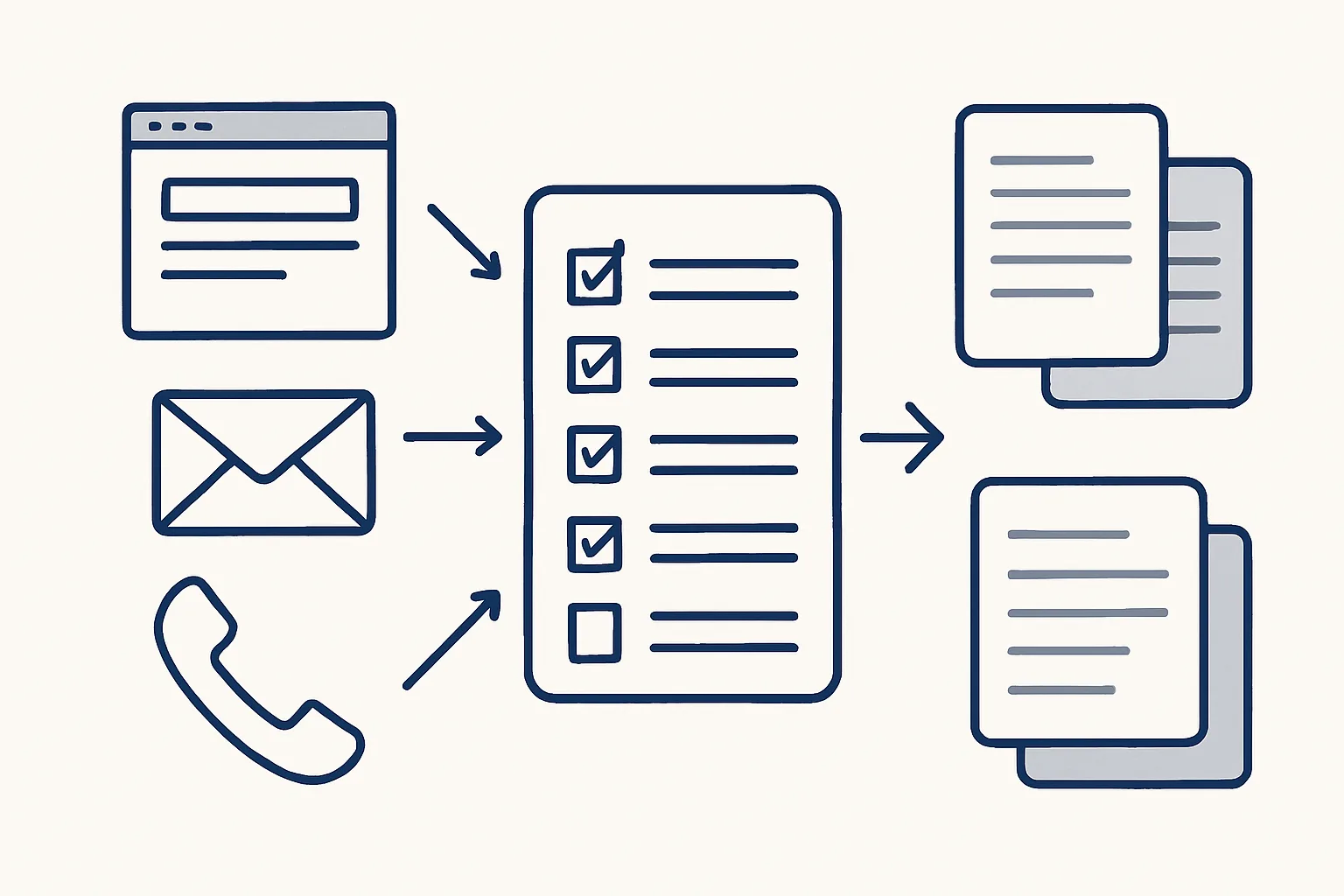
An AI sales assistant for incoming enquiries logs every request on one register, prepares a first reply from your own past answers and prices, and has the follow-up ready when a reply is due. Every enquiry gets a reply on time, and there is no cold outreach.
Where enquiries get lost
Enquiries get lost between the moment they arrive and the moment someone owns them, and that gap is what an AI sales assistant for incoming enquiries is built to close.
Most small businesses do not lack enquiries so much as lose track of them. A request comes in through the website form and lands in a shared mailbox. Another arrives by email to a salesperson who is travelling. A third is a voicemail someone wrote on a note. Each one is answered eventually, or not, depending on who saw it and how busy the week was.
The losses are quiet. Nobody decides to ignore a customer; the enquiry simply sits unanswered until it is too late to matter, or the first reply goes out but the follow-up never does. Because no single list exists, nobody can say how many were missed.
An AI sales assistant in this sense is not a chatbot on your website and not a tool that writes to strangers. It is a back-office helper that makes sure every request someone sends you is recorded, answered and followed up, by a person, on time.
Typical places where enquiries slip through:
- A shared mailbox where everyone assumes someone else has replied.
- A website form that emails one person who is away.
- Requests that arrive in a personal mailbox and are never logged.
- Replies that wait for a price or a detail nobody chases.
- First replies sent, but no follow-up when the customer goes quiet.
- No list showing which enquiries are open and who owns each one.
One register for every enquiry
The foundation is a single register in your own sheet, where every incoming enquiry is logged with its source, date, customer, request and owner.
Everything else an AI sales assistant does depends on this list. Drafts and follow-ups need somewhere to hang, and the team needs one place to see the whole picture instead of several inboxes.
The robot watches the places enquiries arrive, such as the sales mailbox and the website form notifications, and adds a row for each new request. It reads who is asking, what they want and how to reach them, and links the row to the original message. If an enquiry comes from an existing customer, it notes that too.
Each row has a status: new, replied, waiting for the customer, waiting for us, won, lost. The team updates it as the conversation moves, and the robot updates it when it sees a reply go out. At any moment, one look at the register shows what is open and whose turn it is.
This is offered and built to order on the same engine as the work we run today, such as the daily mail digest that lists each morning's new and unanswered emails across several mailboxes.
| Register column | What it holds | Filled by |
|---|---|---|
| Received | Date and time the enquiry arrived | The robot |
| Source | Website form, sales mailbox, personal mailbox, phone note | The robot, or a person for calls |
| Customer | Name, company and contact, flagged if already a customer | The robot |
| Request | A short summary, with a link to the original message | The robot |
| Owner | Who is handling it | A person |
| Status and next date | Where it stands and when the next reply is due | Both |
Draft first replies
For each new enquiry, the assistant prepares a first reply from your own past answers, documents and prices, and leaves it in the mailbox, ready for your approval.
Good first replies are fast and specific. The draft draws on how your team has answered similar requests before, your product information and your latest prices, so it sounds like your business rather than a template. Where details are missing, such as a quantity or a delivery address, the draft asks for them.
Over time the drafts improve in a simple way: as your team edits and sends replies, those sent replies become part of the past answers the AI sales assistant draws on next time. Your own wording, not a generic script, shapes what it prepares.
The draft sits in the same thread as the enquiry, in the sending address the customer wrote to. At the start you read it, correct anything that needs correcting and press send. If the request is unusual, or the robot cannot find a sound basis for a reply, it says so on the register instead of guessing.
This is the difference between a useful sales assistant AI and a risky one. A draft that is wrong costs a minute to fix; an automatic reply that is wrong can cost the customer.
Follow-ups when a reply is due
When a reply is due and nothing has gone out, the assistant prepares a draft follow-up and flags it on the register, so no conversation dies of neglect.
Automated lead follow up usually means one of two things. In the version some tools offer, a sequence of emails goes out by itself on a schedule. In ours, the robot notices that a customer has not replied, or that we owe them an answer, and prepares the follow-up for the owner of the enquiry.
Here is how one enquiry moves through the routine:
- An enquiry arrives through the website form and is logged on the register.
- The robot prepares a draft first reply from your past answers and prices.
- The owner checks the draft, adjusts it and sends it; the register shows replied.
- The agreed number of days passes with no answer from the customer.
- The robot prepares a short draft follow-up in the same thread and flags it.
- The owner sends it, edits it or marks the enquiry as closed.
- Every step is written to a log of actions.
Where do your enquiries get lost?
Think about the enquiries your business received last month. Tick each statement that is true.
What a person always does
A person always sends every message, sets every price that is not already agreed, and decides when an enquiry is won, lost or not worth pursuing.
An AI powered sales assistant can read, sort, log and draft. It cannot judge whether a customer is serious, whether a discount is wise or whether a request falls outside what you want to do. Those decisions shape the business and stay with the people who run it.
It also stays within clear limits. It works on incoming enquiries only: no cold outreach, no bought lists, no mass mailing. Virtual sales assistants that write to strangers on your behalf are a different product, with different risks to your reputation and your mailbox, and this is not one of them.
Every action is written to a log, anything the robot cannot do exactly goes to a person instead of being guessed, and one command stops it.
What it does not do
An AI sales assistant built this way does not sell, negotiate or make promises; it keeps the paperwork of selling in order so people can do those things.
It will not chase a customer who has said no, invent a delivery date or offer a discount nobody approved. It does not score leads by guesswork or decide which customers deserve attention. And because every message is a draft, it never speaks for the business without someone reading what it wrote first.
This is a deliberate choice, and it is the same way all our AI employees work: the paperwork is ready, in your own words, when it is due. Drafted enquiry replies and follow-ups are offered and built to order; they are not yet running for a client.
Getting started
Start by finding out where your enquiries arrive today and how many go without a timely reply, then decide whether a register alone would fix it.
Sometimes the register is enough. Seeing every enquiry in one list, with an owner and a next date, changes habits by itself. Where the team still struggles to keep up, the drafted replies and follow-ups take the writing off them.
Our AI employees are rented monthly, run on our servers and work inside your own mailbox and sheets. The register stays in your own spreadsheet, the drafts stay in your own mailbox, and if the rental stops, everything remains where it was. Nothing is switched on without your yes.
Use the self-check above to see where enquiries leak in your business, and note roughly how many enquiries you receive each month and how long a good first reply takes. Those two figures say more about whether an AI sales assistant fits than any feature list.
Questions
What does an AI sales assistant do?
In our version, it logs every incoming enquiry on one register, drafts a first reply from your own past answers and prices, and drafts follow-ups when a reply is due. At the start you send every message.
Does the AI sales assistant email customers by itself?
No. Every reply and follow-up is a draft in your own mailbox. A person checks it and presses send.
Can it do cold outreach or send to a list?
No. It works on incoming enquiries only: no cold outreach, no bought lists and no mass mailing.
What is automated lead follow up?
It is a routine that notices when an enquiry is waiting for a reply and acts on it. In ours, the action is a draft follow-up for the owner of the enquiry to send.
Where is the enquiry register kept?
In your own spreadsheet. The original messages stay in your own mailbox, linked from each row, and stay there if you stop the service.
Tell us your workflow. We will build it around you.
Write to [email protected] with how many enquiries you receive each month and how long a good first reply takes, and we will tell you plainly whether an AI sales assistant fits.
Talk to us Related service: Enquiries and follow-up

