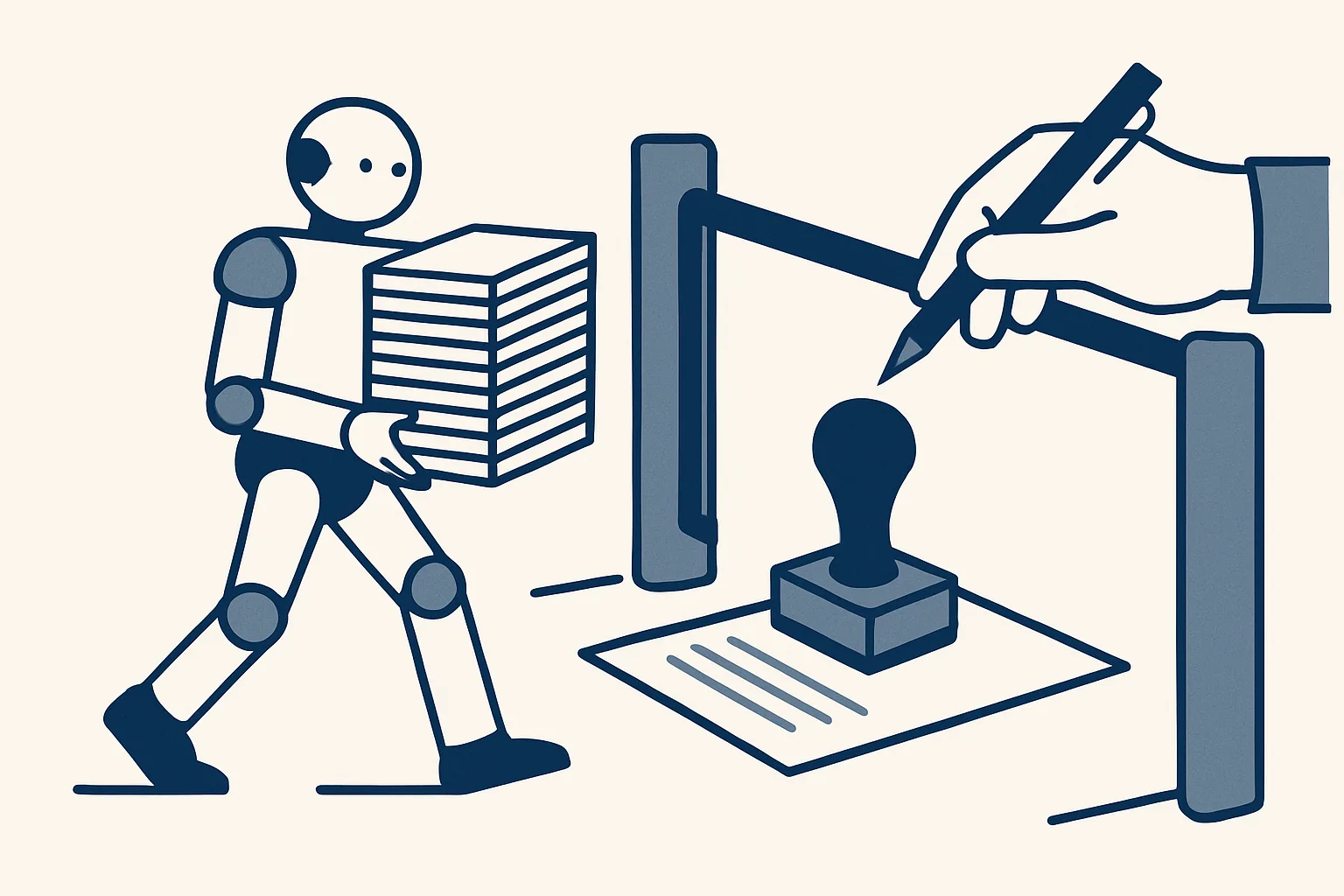
Autonomous AI agents can plan and carry out multi-step tasks without being told each step, but for business work that touches money, customers or contracts, full autonomy is a risk. The safe pattern is an agent that does all the preparation and earns its autonomy step by step, with your approval first.
What 'autonomous' really means
Autonomous AI agents are programs that receive a goal, work out the steps themselves and carry them out across several tools without a person directing each move.
An ordinary chat assistant answers one question and waits. An agent is given a job, such as 'deal with this supplier invoice', and decides on its own to open the email, read the attachment, look up the supplier, enter the figures and file the document. The word autonomous describes that freedom to choose the next step.
Suppliers describe autonomous AI agents in very different ways. Some mean a chat assistant that can click buttons in a browser; others mean a background program that watches a mailbox and acts on what arrives. Before comparing products, ask one plain question: what can this agent do without a person pressing a button, and what happens if it gets that step wrong?
Autonomy is a scale, not a switch. At one end the agent only suggests; at the other it acts on everything, including sending, paying and signing. Most of the useful ground lies in between: the agent plans and prepares freely, then stops at the points where the business carries a real consequence.
That middle ground is what this article argues for. Autonomous AI agents are very good at preparation, and preparation is most of the work. The final act, the one that commits the company, is where a person still belongs.
How agentic AI differs from traditional automation
Traditional automation follows a fixed script written in advance, while agentic AI decides the steps as it goes, which makes it more flexible and less predictable.
People who ask how does agentic AI differ from traditional automation usually have a rules engine or a recorded macro in mind. Those tools do exactly what they were told: if the email subject contains a word, move it to a folder. They break as soon as the input changes shape, but they never surprise you.
Agentic AI automation reads the situation and picks an approach. It can handle a supplier who changed their invoice layout, an email written in another language or a scan that is slightly crooked. The price of that flexibility is that its choices need checking, because a model can be confidently wrong.
The table below sets traditional automation and autonomous AI agents side by side.
| Question | Traditional automation | Agentic AI |
|---|---|---|
| How are the steps decided? | Written in advance by a person | Chosen by the agent as it works |
| What happens with an unfamiliar input? | It stops or fails | It tries to work it out |
| How predictable is it? | Fully, within its script | Mostly, but it can misread |
| What does it need from you? | Exact rules for every case | A clear goal, limits and examples |
| Where is it strongest? | Simple, identical, high-volume steps | Reading messy documents and varied requests |
| What is the main risk? | Silent gaps when inputs change | A confident mistake acted on without review |
Where autonomy is fine
Autonomy is fine for actions that stay inside the company, can be undone easily and leave a record of what changed.
Many steps in office work have no outside consequence at all. Filing a PDF in the right folder, adding a row to an internal register, renaming a document or flagging an email for attention can all be reversed in seconds. If the agent gets one wrong, a person moves it back and nothing has left the building.
These are the steps where AI agents for automation earn their keep without much supervision. They are also where most of the hours go, because they repeat many times a day. The list below is typical of what can safely run alone, provided every action is written to a log:
The rule of thumb is simple. If a person could undo the action quietly in under a minute, and nobody outside the company would ever see it, autonomous AI agents can usually take it on alone. If not, the step belongs behind a draft.
- Reading incoming emails and attachments and sorting them by type.
- Filing documents by month, supplier or client in shared folders.
- Updating internal registers and sheets that only the team uses.
- Preparing a morning summary of new and unanswered mail.
- Flagging an email that does not belong to any known thread.
- Checking a document for missing fields and noting what is absent.
Which actions would your agent take on its own?
Think of an agent you are considering. Tick each action it would carry out with no person approving first. Filing documents and updating internal sheets are not on the list, because they can usually run alone with a log of every action.
Where it is a risk
Autonomy is a risk wherever an action leaves the company, moves money or creates an obligation, because those actions cannot simply be taken back.
An email to a customer, once sent, has been read. A payment, once made, has to be chased back. A contract, once accepted, binds the company. A posted entry in the accounts may already be part of a tax return by the time anyone notices. In each case a small misreading by the agent turns into a real cost, and sometimes an awkward conversation.
There is also a quieter risk: accountability. When an autonomous agent sends a wrong price to a client, the client does not blame the software. They hold the business responsible, and the business has to explain a decision that no person actually made.
None of this means autonomous AI agents are reckless. It means that in business the cost of an error is unequal. Filing a document in the wrong folder costs a minute; sending a wrong invoice can cost a relationship. Sensible design gives the agent freedom where errors are cheap and puts a person at the gate where they are not.
The draft-and-approve pattern
Draft-and-approve means the agent does all the preparation and stops at a finished draft, which a person checks and then sends, posts or signs.
This is the pattern our AI employees run under: the robot does the whole preparation and stops at a finished draft. They are rented monthly, run on our servers and work inside the client's own mailbox, folders, sheets and accounting system. Running today, that covers sales invoicing, supplier bills, purchase orders, invoice filing and a daily mail digest. Drafted customer replies and enquiry follow-ups are offered and built to order on the same engine.
Here is how one piece of ai agent automation travels through the pattern, using a supplier bill at a wholesale business as the example:
Notice what the pattern keeps and what it removes. The agent still does the reading, the checking, the typing and the filing, which is where the time goes. The person keeps only the decision, which takes far less time when the draft is complete and the source document is attached beside it. That is how autonomous AI agents can save effort without taking over responsibility.
It also changes how mistakes surface. A misread figure in a draft is caught at the gate, by the person who approves it, instead of being found weeks later by a customer or an accountant.
- A supplier invoice arrives by email or is dropped into a shared folder.
- The agent reads the supplier, number, date and amounts, and checks them against the supplier list.
- If everything is clear, it creates a draft bill in the accounting system with the PDF attached and files the PDF.
- If anything is unclear, such as an unknown supplier or a refund, it stops and hands the document to a person instead of guessing.
- A person opens the draft, checks it and approves it. Payment is always made by a person.
- Every step, including what the agent could not do, is written to the log.
A log of every action and a stop switch
A log of every action and a stop switch are the two controls that make any agent, autonomous or not, safe to rely on.
The log answers the question 'what did it do and why?' long after the event. For each action it notes what arrived, what was read, what was created and what was passed to a person. When an accountant queries an entry or a client asks about an email, the answer is written down rather than reconstructed from memory.
The stop switch answers a different question: 'how fast can we halt it?' Ours stops any robot with one command. It matters most on the day something unusual happens, such as a supplier changing bank details or a flood of odd emails, and a person wants everything paused while they look.
Two further habits complete the picture. Nothing is switched on without the client's yes, and anything the robot cannot do exactly goes to a person. Together these turn autonomous AI agents from a gamble into a dependable assistant: free to prepare, unable to commit the business, and fully visible when anyone wants to check. Before trusting any agent with your work, ask its supplier to show you all four controls in practice.
Questions
What are autonomous AI agents?
They are programs that receive a goal, decide the steps themselves and carry them out across several tools, such as a mailbox, a folder and an accounting system, without a person directing each step.
How does agentic AI differ from traditional automation?
Traditional automation follows a script written in advance and stops when inputs change. Agentic AI chooses its steps as it works and copes with varied inputs, but its choices need checking because it can misread.
Can AI agents send emails or pay bills by themselves?
Technically many can. Ours do not: every step starts with your approval, you move a step to automatic only when it has proven itself, and payments stay with you.
Is it safe to give an AI agent access to business accounts?
It can be, with limits. Look for drafts instead of direct actions, a log of every step, unclear cases passed to a person and a way to stop the agent at once.
What is the difference between an AI agent and a chatbot?
A chatbot answers questions in a window when you type. An agent starts from events in the business, such as a new email, and carries a task through to a result.
Tell us your workflow. We will build it around you.
Write to [email protected] with one job and the hours it takes you each month, and we will tell you plainly which steps an agent will prepare and which stay with you.
Talk to us Related service: Services

