Send a follow up email after no response once a reasonable wait has passed: keep it short, restate the one thing you need and make replying easy. For incoming inquiries, a register that shows when a reply is due lets drafts be prepared on time for a person to send.
When to follow up
Send a follow up email after no response once the person has had a fair chance to reply, which depends on what you asked and how urgent it is for them, not only for you.
Silence rarely means no. Most unanswered emails are simply buried: the reader meant to reply, needed to check something first, and the message slid down the inbox. A polite nudge is usually welcome, as long as it arrives after a sensible wait and does not read as pressure.
Timing also depends on the channel the person prefers. Someone who always answers by phone may never reply to email at all, and a follow up email after no response from that person is less useful than a short call. Notice how each contact usually replies, and use that.
A useful rule of thumb is to match the wait to the request. A quick factual question deserves a quicker nudge than a request that needs the other side to gather documents, get approval or think. If you gave a date in your first email, follow up just after it. If the matter has a real deadline, say so plainly in the first message, so the follow-up is not a surprise.
The table gives a rough guide by situation. Treat it as a starting point and adjust it to the people you deal with.
| Situation | Reasonable first wait | Tone |
|---|---|---|
| A client has a quote from you | About a week | Helpful: offer to answer questions |
| A supplier owes you a price or a date | A few working days | Direct: restate what you need and by when |
| Someone sent you an inquiry and went quiet after your reply | About a week | Light: check the answer reached them |
| An invoice is overdue | Shortly after the due date | Polite and factual: amount, invoice, how to pay |
| A colleague or partner owes a decision | Before the date it is needed | Plain: the decision, and what waits on it |
What to write
Write a follow-up that is short, restates the one thing you need, and makes replying take seconds.
Knowing how to follow up on an email well is mostly knowing what to leave out. Do not repeat the whole first message. Do not apologize for writing, and do not hint that the reader has failed. Reply in the same thread, so the history is one scroll away, and keep the subject line as it was.
A good short follow up email after no response usually has four parts.
Tone matters as much as length. A follow up email after no response that sounds annoyed gets a slower reply, not a faster one. Read it once as the recipient would, on a phone between meetings, and cut anything that would make you feel chased.
- Open with a friendly line that refers to the earlier email, without blame.
- Restate the one thing you need, in a single sentence.
- Make the reply easy: a yes or no question, two options, or an offer to call.
- Close with a date if there is a real one, and your name.
Examples by situation
The best example is short and specific to the situation: a quote, a supplier, an inquiry or an unpaid invoice each needs a slightly different line.
These are written to be adapted, not copied word for word. Each is a reply in the original thread. Notice that none of them is longer than a few lines, and each asks for one thing.
This is also how to politely follow up on an unanswered email without sounding impatient: assume good faith, keep the request clear, and offer an easy way out.
- A follow up email after no response from client, after a quote: Hello, I wanted to check the quote reached you safely. Happy to adjust anything or answer questions; would a short call this week help?
- To a supplier who owes a price or date: Hello, following up on the request below. Could you confirm the price and the earliest delivery date by the end of the week? That lets us confirm our own order.
- To someone who sent an inquiry and went quiet: Hello, just checking my reply below reached you. If the timing is not right, no problem at all; let me know and I will close this for now.
- On an unpaid invoice: Hello, a reminder that the invoice below is now past its due date. Could you let me know when payment is planned? If it has already been paid, thank you, and please ignore this note.
- To a colleague who owes a decision: Hello, the order below is waiting on your yes or no. A one-word reply is enough.
Is your follow-up ready to send?
Write your follow-up, then tick each statement that is true of it. The more you tick, the more likely it is to get a reply.
How many follow-ups
Two or three follow-ups, spaced further apart each time, are usually enough; after that, close the thread politely.
Space them out. The second follow-up can wait longer than the first, and the third longer again. That rhythm shows patience and gives the reader room, while still keeping the matter alive.
Each follow-up should add something: a new date, a simpler question, a different way to reply. Sending the same nudge again and again trains the reader to ignore you. The last one can say plainly that you will close the matter unless you hear back, which often draws a reply because it gives the reader an easy end.
For an unpaid invoice, the sequence follows your own terms and can move from a reminder to a phone call. For anything about collection beyond that, check with your adviser.
If a person still has not answered after a final, polite note, a phone call or a different contact at the same company may be better than another email.
Keeping track of who is waiting
Follow-ups slip when nobody can see who is waiting for what; a simple register with one row per open inquiry and a date when a reply is due fixes that.
Most missed follow-ups are not a writing problem. They are a memory problem. The thread is buried, the person who sent it is away, or nobody knows whose turn it is. A register makes the waiting visible: who wrote, what they asked, what you replied, and when the next step is due.
Keep the register in a shared sheet, so anyone on the team can see it. Each row is one incoming inquiry or open request. The columns are the contact, the subject, the date of the last message in each direction, whose turn it is, and the date a follow-up is due. When the date passes, the row is flagged.
That view also shows a pattern worth noticing: which kinds of inquiry stall, at which step, and how long they wait. Often the fix is not a better follow up email after no response, but a clearer first reply.
Preparing drafts automatically
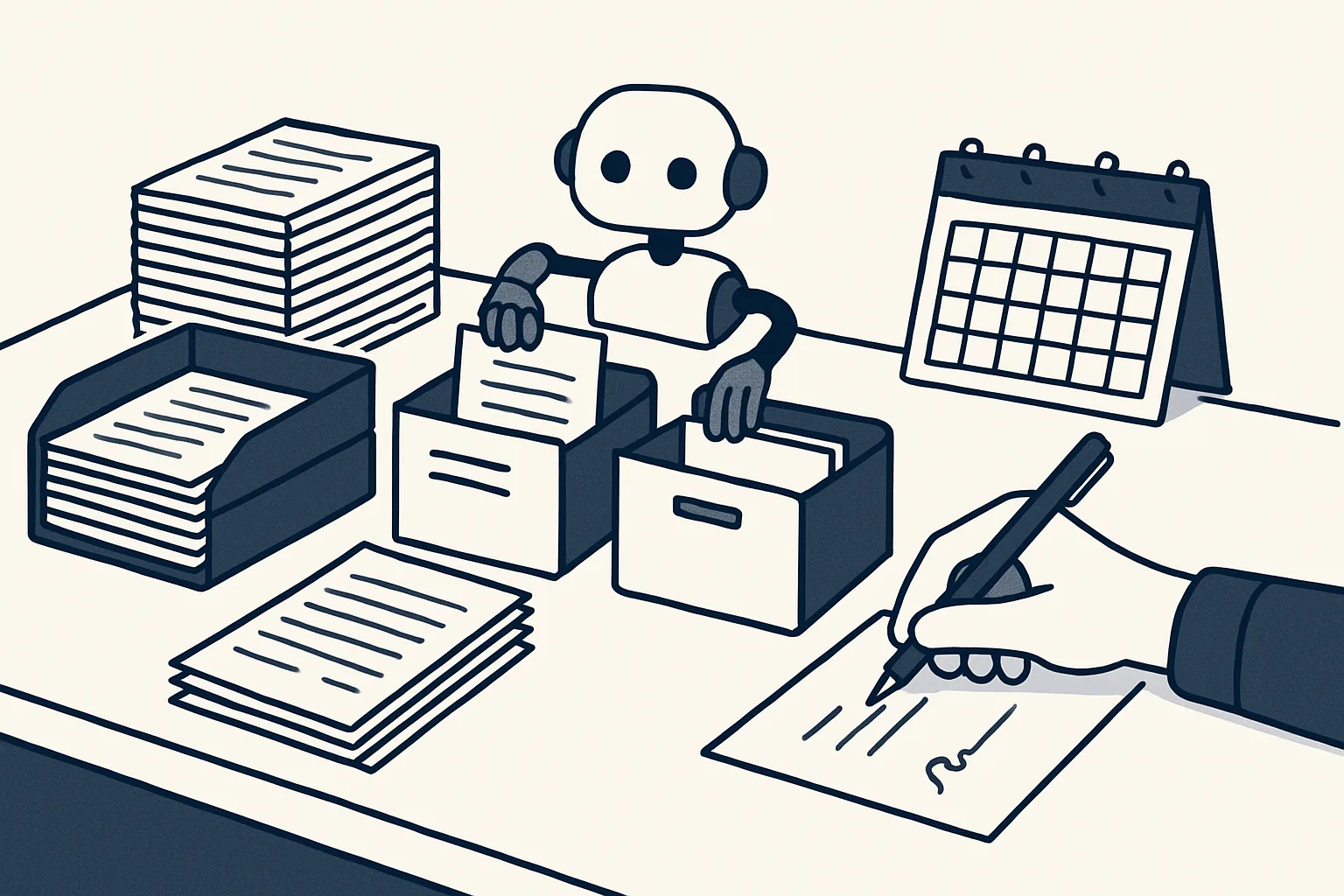
When a reply is due on the register, a robot can prepare the follow up email after no response as a draft in the right thread, for a person to check and send.
This is offered and built to order. Incoming inquiries are logged on one register as they arrive, a draft first reply is prepared, and when a follow-up is due a draft appears in the same thread, written from your own past messages and the situation on the row. A person reads it, edits if needed and presses send. Nothing is ever sent by a robot.
The value is not in clever wording. It is that each follow up email after no response is ready on the day it is due, in the right thread, with the history in view, so the person on duty only has to read, adjust and send.
It covers incoming inquiries and your existing contacts only. There is no cold outreach, no bought lists and no mass mailing. Every action is written to an audit record, a kill switch stops any robot in one command, and nothing is switched on without your yes.
Our AI employees are rented monthly and run on our servers against your own mailbox and sheets, so every inquiry, draft and reply stays in your own account. Before you start, count the job by your own rule: how many inquiries and follow-ups a week, and how long each one takes today.
Questions
How long should I wait before sending a follow-up email?
Match the wait to the request: a quick question deserves a quicker nudge than one that needs documents or approval. If you gave a date in the first email, follow up just after it.
How do I write a short follow up email after no response?
Reply in the same thread with a friendly opening line, one sentence restating what you need, an easy way to answer, and your name.
Is it rude to follow up on an unanswered email?
Not when it is polite and spaced sensibly. Most unanswered emails are buried, not refused, and a short nudge is usually welcome.
How many times should I follow up?
Usually two or three times, further apart each time, with the last one saying you will close the matter unless you hear back.
Can a robot send follow-ups for me?
Ours prepares follow-ups as drafts when a reply is due on your register; a person checks and sends each one. It covers incoming inquiries and existing contacts only, never cold outreach.
Want hours back from this work?
Write to [email protected] with how many inquiries and follow-ups your team handles each week and how long they take, and we will tell you plainly whether drafted follow-ups fit.
Talk to us Related service: Enquiries and follow-up