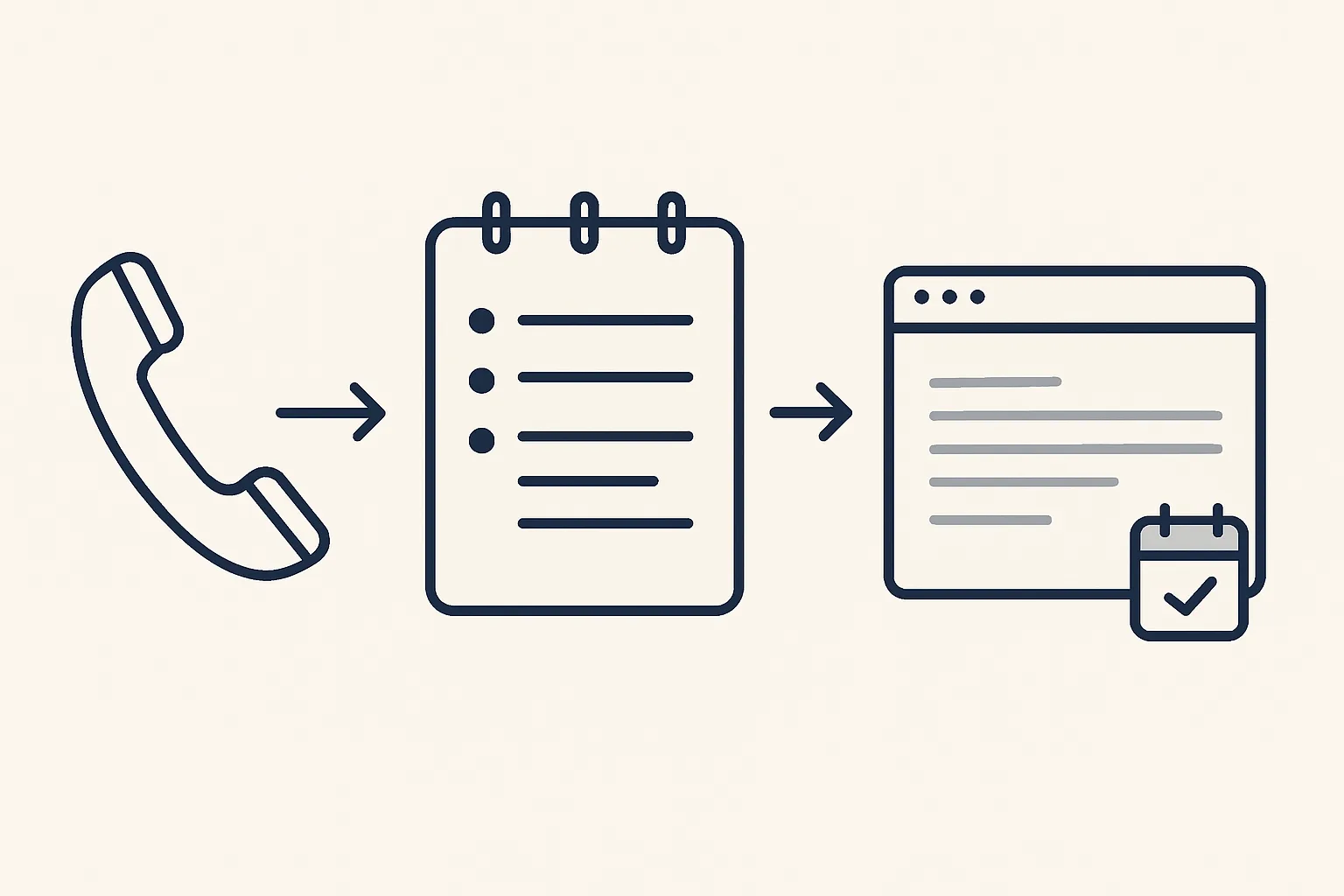
A good sales call follow-up email goes out the same day, thanks the person briefly, lists what was agreed with owners and dates, attaches what was promised and names the next step. Your notes or a recording of the call become that email, ready when you are.
Why the follow-up matters
The sales call follow-up email turns a good conversation into a written record that both sides can act on.
On a call, people agree to things quickly: a price to confirm, a sample to send, a colleague to introduce, a date for the next talk. By the next morning, each side remembers a slightly different version. The follow-up fixes the version you both work from, and it shows the other person that you listened.
It also protects you. If a question comes up weeks later about what was promised, the email is there, dated and specific. A follow-up that only says thanks and nice to talk to you misses both purposes.
One limit is worth saying at the start. This guide is about following up after a real conversation with someone who agreed to talk to you. It is not about cold sales emails to strangers, which follow different rules and which we do not write.
What to include
Include a short thank-you, the points agreed, who does what by when, anything you promised to attach and one clear next step.
Each item has a job. The thank-you is one line, not a paragraph. The agreed points are the record. The owners and dates turn the record into actions. The attachments prove you meant it. The next step stops the conversation drifting.
Tone matters as much as content. Write the way you spoke on the call: plain, friendly and specific. Avoid stock phrases about touching base or circling back, and avoid a second sales pitch. If you mention a price, make it the exact figure you discussed, and if something is still to be confirmed, say so in those words. A sales call follow-up email that is accurate and modest earns more trust than one that is polished and vague.
- A subject line that names the call and the date, so it can be found later.
- One line of thanks, with one specific detail from the conversation.
- The points agreed, as a short list in plain words.
- Actions, each with an owner and a date, on both sides.
- The documents, prices or links you promised, attached or linked.
- The next step: a meeting, a decision or a reply, with a proposed date.
- Your name and a direct way to reach you.
A simple structure
A simple structure runs top to bottom: subject, thanks, summary, actions, attachments, next step, signature.
Most sales emails are too long because the writer is still selling. After a call, the selling is mostly done; the email is a record. Keep it short enough to read on a phone, and put the actions where they cannot be missed. The table shows each part and an example line from a generic trade.
| Part | What it does | Example line |
|---|---|---|
| Subject | Makes the email easy to find | Our call today: delivery schedule and next steps |
| Thanks | Shows you listened | Thank you for walking me through how your warehouse receives goods. |
| Summary | Records what was agreed | We agreed to quote for the standard range, delivered monthly. |
| Actions | Sets owners and dates | I will send the quote by Thursday; you will confirm the delivery address. |
| Attachments | Delivers what was promised | The product sheet we discussed is attached. |
| Next step | Keeps things moving | Shall we speak again next Tuesday morning to go through the quote? |
| Signature | Makes reply easy | Your name, role and direct phone line. |
Examples for common situations
The right sales email after a call depends on how the call ended: with a clear next step, with an open question or with no reply afterwards.
When the call ended with a clear next step, the follow-up is short. Thank them, confirm the step and the date, attach what was promised. Example: Thank you for your time today. As agreed, the quote for the standard range is attached, and I have put Tuesday morning in the diary to go through it. If anything changes on your side before then, just reply here.
When the call ended with an open question, name the question and who is finding the answer. Example: Thank you for the call. The one open point is whether delivery can be split across your two sites; I am checking with our transport team and will come back to you by Friday with an answer.
When several people were on the call, address the email to all of them and put each action next to the right name. Example: Thank you all for your time this afternoon. Actions from the call: Anna will send the current supplier list by Wednesday; I will prepare a sample order for your review by Friday; we will all meet again the following Monday. Copying the whole group avoids the version where each person forwards a different summary.
Then there is the follow up email after no response from client. Wait a reasonable time, then send one short, polite note that adds something useful rather than repeating the first email. Example: I wanted to make sure the quote reached you. I have also added the delivery times you asked about. Is the next step still a decision this month, or has the timing changed? If there is still no reply, accept it, note it on your register and stop. Repeated chasing of someone who has gone quiet is not follow-up.
Is your follow-up email ready to send?
Open the draft of your last follow-up after a call. Tick each statement that is true of it.
Turning call notes into a draft
Call notes or a recording can be turned into a draft follow-up automatically, with the agreed points, actions and dates in place.
This is part of our meeting minutes service, which is offered and built to order, not running for a client today. The robot works from notes you type or from a recording of a call you chose to record. Recording rules differ from place to place, so tell the other side and get their agreement first, and check the rules that apply to you with your adviser.
Here is how a sales call follow-up email is drafted from the call:
- You save your notes, or the recording of a call both sides agreed to record, in a shared folder.
- The robot reads them and pulls out what was agreed, the open questions, the actions, the owners and the dates.
- It writes a draft email in your mailbox, in the structure above, addressed to the people on the call.
- It lists the documents that were promised so you can attach them, or attaches files it can find in your folders.
- You read the draft, correct anything it got wrong and press send yourself.
- The actions and dates are written to your register, and every step goes to the log.
Tracking the next step
The next step only happens if someone tracks it, so every follow-up should end up as a row on a register with an owner and a date.
A register can be as simple as a shared sheet: who you spoke to, when, what was agreed, the next step and its date. When the date passes without an answer, the row shows it. This is where knowing how to send a follow up email at the right moment matters more than the wording.
Review the register once a week. Rows with a date in the past and no reply are the follow-ups to write; rows with a decision recorded can be closed. A short weekly look is usually enough to stop good conversations from going cold simply because nobody remembered to write.
Our enquiries and follow-up service, also offered and built to order, keeps that register for incoming enquiries and prepares a draft follow-up when a reply is due. It handles incoming enquiries only: no cold outreach, no bought lists and no mass mailing. The draft waits in your mailbox, in the right thread, on the day it is due.
What drafting does not do
A drafted follow-up saves typing; it does not decide what you offer or how you speak to a customer.
The robot can only write down what was said or noted. If the notes are thin, the draft will be thin. It will not invent a price, commit to a delivery date or promise a discount, because those are decisions for a person. It will not send the email, and it will not chase anyone by itself. You read every sales call follow-up email at first, and the tone stays yours.
Questions
How soon should I send a follow-up after a sales call?
The same day if you can, while both sides remember the details. The next morning is acceptable. After that, the summary starts to read like a reconstruction rather than a record.
What do I write in a follow-up email after a sales call?
A one-line thank-you, the points agreed, the actions with owners and dates, the documents you promised and one clear next step with a proposed date.
How do I follow up when a client has not replied?
Wait a reasonable time, then send one short, polite email that adds something useful, such as an answer to a question they raised, and asks whether the timing has changed. If there is still no reply, note it and stop.
Can AI write my sales follow-up emails?
It can draft them from your notes or from a recording of a call both sides agreed to record. The prices and commitments in the email are only ever the ones in your notes, so it starts with your read.
Is it legal to record a sales call?
Rules differ from place to place. Always tell the other side and get their agreement before recording, and check the rules that apply to you with your adviser.
Tell us your workflow. We will build it around you.
Write to [email protected] with how many calls you follow up each week and the time each email takes. We will tell you plainly whether drafting them from your notes fits your work.
Talk to us Related service: Meeting minutes

