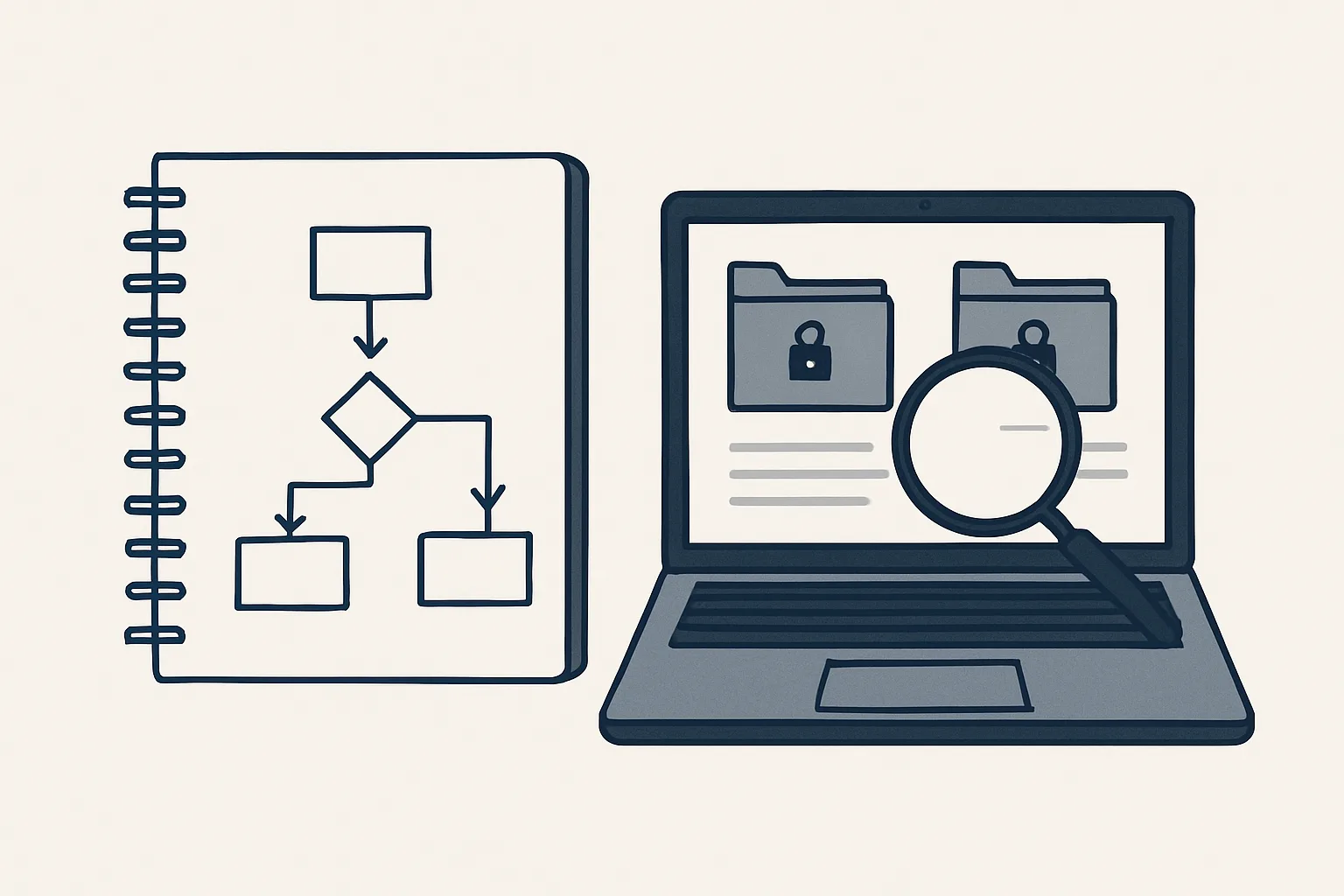
Good AI automation consulting starts by reading how the work is done today, in the emails, files and ledgers, before proposing anything. The result is a short list of jobs worth automating, what each robot will draft, who approves it and one plain monthly price per job.
What an AI automation consultant actually does
An AI automation consultant studies how your office work is done today and tells you, in writing, which parts are worth automating, how and at what price.
AI automation consulting sits between a conversation and a build. It is the stage where someone outside the business looks at the routine work closely enough to say what a robot could prepare, what must stay with people and what would not be worth automating at all. Business process automation consulting and workflow automation consulting describe the same stage with different words; so do many offers sold as AI consulting services.
Done well, it is mostly reading and asking. A consultant who arrives with a ready-made answer before seeing any of your work is selling a product, not advising. Done badly, it ends with a slide deck full of possibilities and no clear first step.
Our version starts with a plain answer, not a pitch. Three lines are enough to begin: what you do, which tasks take your time and roughly how many hours a week they cost. From that, we can usually say whether an AI employee fits at all, before anyone looks at a single file.
The read-only review of your current work
The core of AI automation consulting is a read-only review: looking at real emails, files and ledgers to see how the work actually happens, not how it is described.
People describe their own routines from memory, and memory smooths things out. The real work trail shows the exceptions: the supplier who sends invoices as photos, the customer who orders by replying to an old thread, the spreadsheet only one person understands. Those are exactly the cases an automation has to handle, so they need to be found before anything is designed.
The review is read-only and runs only with your permission, on the accounts you choose. Nothing is created or changed. Typical things it looks at:
- The mailboxes where work arrives: orders, supplier invoices, requests, questions.
- The folders where documents are filed, and how consistently.
- The sheets and registers people keep by hand.
- The accounting records: how invoices and bills are entered, coded and attached.
- Who handles each step today, and who signs the result.
Choosing the jobs worth automating
The jobs worth automating are the ones that repeat often, follow rules you can write down and end in a document, an entry or an email that a person can check quickly.
Every business has more candidates than it should start with. The review usually turns up a long list; the consulting work is in cutting it down. A job that happens rarely, or that needs a judgment call every time, may be real work but a poor candidate. A job that happens every day by the same rules, and that someone types by hand, is usually a good one.
In AI automation consulting, this is also where the size of each job becomes clear. Counting how many orders, bills or requests arrived over a few months, rather than guessing, turns a vague wish into a job that can be priced.
Each job we build follows the same six steps, whatever it is: the work is read from email, files or sheets; sorted into one clean record; checked against what the business already knows, such as client and product memory; decided and routed by its rules; prepared as a draft; and approved, handed over complete with its source beside it. Mapping a candidate job onto those steps shows quickly whether it fits.
The table shows how candidates are typically sorted.
| Signal | Good candidate | Poor candidate |
|---|---|---|
| How often it happens | Daily or weekly | A few times a year |
| Rules | Can be written on one page | Different every time |
| Where the work arrives | One predictable place | Scattered, often by phone |
| The result | A document, an entry or an email | A decision or a negotiation |
| Checking | Faster than doing it by hand | As slow as doing it by hand |
Defining drafts, approvals and limits
For each chosen job, the consulting stage must define exactly what the robot will draft, who approves it and what it must never do.
This is the part most often skipped, and the part that decides whether the automation can be trusted. Under our rules, the answers are fixed: every step starts with your approval, nothing is created or changed without the owner's yes, every action is written to a log and one command stops any robot. What remains to define, job by job, is the detail.
For each job, the definition answers a short list of questions.
- Where does the work arrive, and what starts the robot: a new email, a file in a folder or a row marked ready?
- What exactly does the robot prepare: a draft invoice, a draft bill, a draft email, a register row?
- Where does the draft wait, and who is notified?
- Who approves it, and who can approve when that person is away?
- Which cases must go to a person instead of being guessed, such as unknown suppliers, refunds or missing data?
- What is the robot never allowed to do: send, pay, delete or create a new supplier or customer without approval?
Are you ready for a consulting review?
Tick what you already have. Every unticked line is an item for your to-do list before the first conversation.
The written proposal
The consulting stage should end in a short written proposal: the jobs worth automating, what each robot will draft, who approves it and one plain monthly price per job.
This is the deliverable that AI automation consulting should be judged on.
A proposal you cannot summarize in a few lines is a warning sign. Ours lists the jobs in the order they would be built, describes each in plain words, states the approvals and limits defined above and gives one monthly figure per workflow. The price depends on the hours the job takes out of your routine and on how complex the automation is; a job that needs several AI employees working together costs more to build and run than a simple one.
It also says how the service is run. The AI employees are rented monthly: we build them, run them on our servers against your own accounts and look after them. There is no one-off sale. If the rental stops, the workflow stops, and every record stays in your own mailbox, folders, sheets and accounting system.
How long will it take? It depends on the work: simple tasks are live quickly, complex ones take longer. Be cautious with any AI automation consultant who gives a fixed timetable before the review.
The proposal itself is a private web page you can read and sign online. Our signing page records who signed, when and a fingerprint of the exact document, so any later change shows.
When the answer is no
Honest AI automation consulting sometimes ends with the advice not to automate a job, or not yet.
There are good reasons for that answer. The job may happen too rarely to be worth a monthly rental. The rules may live only in one person's head and need writing down first. The work may arrive in so many forms that the first step is to bring it into one mailbox or one folder, which a business can do on its own. Or the job may be mostly judgment, with only a small mechanical part.
A no is still useful. It usually comes with a smaller step that makes a later yes possible, such as a shared register kept by hand for a month, or a single address for supplier invoices. And it tells you something about the adviser: AI automation consulting that never says no is a sales process.
What you should prepare
You can make AI automation consulting faster and more accurate by preparing a few things before the first conversation.
None of it needs to be polished. A rough note, a few real examples and a clear answer on who approves what are worth more than a long description. The readiness check on this page lists the essentials; tick what you already have and the result tells you what to prepare next.
The most useful thing of all is your own count: how often each job happens and how long it takes, by your own rule. That figure, in hours, is what an AI employee is built to give back, and it is the only measure we talk about. We make no promise about how much of it any automation will recover; the review is how both sides find out.
Questions
What does an AI automation consultant do?
They study how your office work is done today, ideally by reading the real emails, files and ledgers, and recommend in writing which jobs are worth automating, how each would work and what it would cost.
What is the difference between AI consulting services and building automation?
Consulting decides what to build and why; building makes it work. With us the two are joined: the review leads to a proposal, and the same team builds and runs what is agreed.
Do you need access to our systems for the review?
Read-only access to the accounts you choose, and only with your permission. Nothing is created or changed during the review.
How long does an automation project take?
It depends on the work. Simple tasks are live quickly; complex ones that need several AI employees working together take longer. The proposal says what applies to yours.
How is the price set?
One monthly figure per workflow, stated in the proposal. It depends on the hours the job takes out of your routine and on how complex the automation is.
Tell us your workflow. We will build it around you.
Write to [email protected] in three lines: what you do, which tasks take your time and roughly how many hours a week they cost, and you will get a plain answer.
Talk to us Related service: Services

