AI employees suit repetitive, rule-heavy jobs with clear inputs, such as bills, invoices, filing and first-draft replies, while new hires are better for judgement, relationships and anything new. Most businesses use both: the AI employee prepares the routine work and people make the decisions.
What each is good at
AI employees do the same written-down job the same way each time it runs; people do everything that needs judgement, context or trust.
An AI employee is an automation with one job description, working inside the tools your business already uses. Some call it a digital worker; searches for AI workers usually mean the same thing. It starts when something happens, such as a bill arriving or a row marked ready, and it carries the job to a draft for a person to check.
A new hire brings what software does not: the ability to handle a situation nobody described, to read a customer's mood, to notice that something feels wrong, to learn the business and to take responsibility. The question is not which is better. It is which work suits which.
It is worth being plain about what AI employees are not. They are not a person in software form. They do not attend meetings, pick up the phone or learn the business by watching. They do what their job description says, inside the accounts they were given access to, and they stop and hand over when something falls outside it.
The comparison below is about the work, not about headcount. It shows where each tends to fit.
| Question | AI employee | New hire |
|---|---|---|
| Best kind of work | Repetitive, rule-based, high volume | Varied, new, judgement-heavy |
| Inputs | Clear and predictable: an email, a file, a sheet row | Anything, including conversations |
| Output | Drafts: entries, documents, emails, register rows | Decisions, relationships, finished work |
| Unclear cases | Passes them to a person | Works them out, or asks |
| Learning the business | Only what is written into its rules | Grows with time and experience |
| Responsibility | None; stays with people | Can own a result |
| Records | Every action in a log | As much as the person writes down |
Tasks to give an AI employee
Give an AI employee the tasks that repeat often, follow rules you can write down and end in a document, an entry or an email someone can check quickly.
The clearest signs are volume and sameness. If a task happens many times a month and the steps barely change, typing and filing it by hand is a poor use of anyone's time. If a person can check the result faster than doing it, the task is a strong candidate.
Here are typical candidates. Each says whether it is running today in our own offer or offered and built to order.
Notice that every item on the list ends in something a person can look at: a draft bill, a draft invoice, a filed PDF, a digest, a draft reply. That is the test worth applying to your own tasks. If you cannot say what the finished draft would look like, the task is probably not ready to hand over yet.
- Entering supplier bills and credit notes as drafts, with the PDF attached and filed. Running today.
- Preparing sales invoices from a sheet, with a draft email beside each. Running today.
- Rendering purchase orders from one row. Running today.
- Filing incoming invoices by month into the accounting folder. Running today.
- A morning digest of new and unanswered emails across several mailboxes. Running today.
- Draft replies to routine customer emails, written from your own past answers. Offered, built to order.
- Draft expense entries from photos of receipts. Offered, built to order.
Tasks to keep with people
Keep with people every task that needs judgement, a relationship, a negotiation or responsibility for the result.
Some work looks repetitive and is not. A complaint may arrive in the same mailbox as an order, but answering it well depends on who the customer is and what went wrong. A supplier price may look like a number to copy, but deciding whether to accept it is a commercial decision.
Keep these with people, even when a robot prepares the paperwork around them: approving and paying anything; agreeing prices and terms; answering complaints and disputes; deciding on new suppliers, customers or staff; anything that is new, rare or sensitive; and signing anything that leaves the company.
This is also where most of the value of a new hire lies. A person spending their week typing invoices is a person not spending it on customers, suppliers and problems that need a human. Handing the typing to an AI employee is a way of giving that time back to work people are good at.
A useful rule of thumb: if a task ever needs a phone call to finish, the call stays with a person, even if the paperwork before and after it is prepared by a robot.
AI employee, person, or both?
Pick one task from your team's week. Tick each statement that is true of it. More ticks point towards an AI employee preparing it; fewer point towards keeping it with a person.
How the two work together
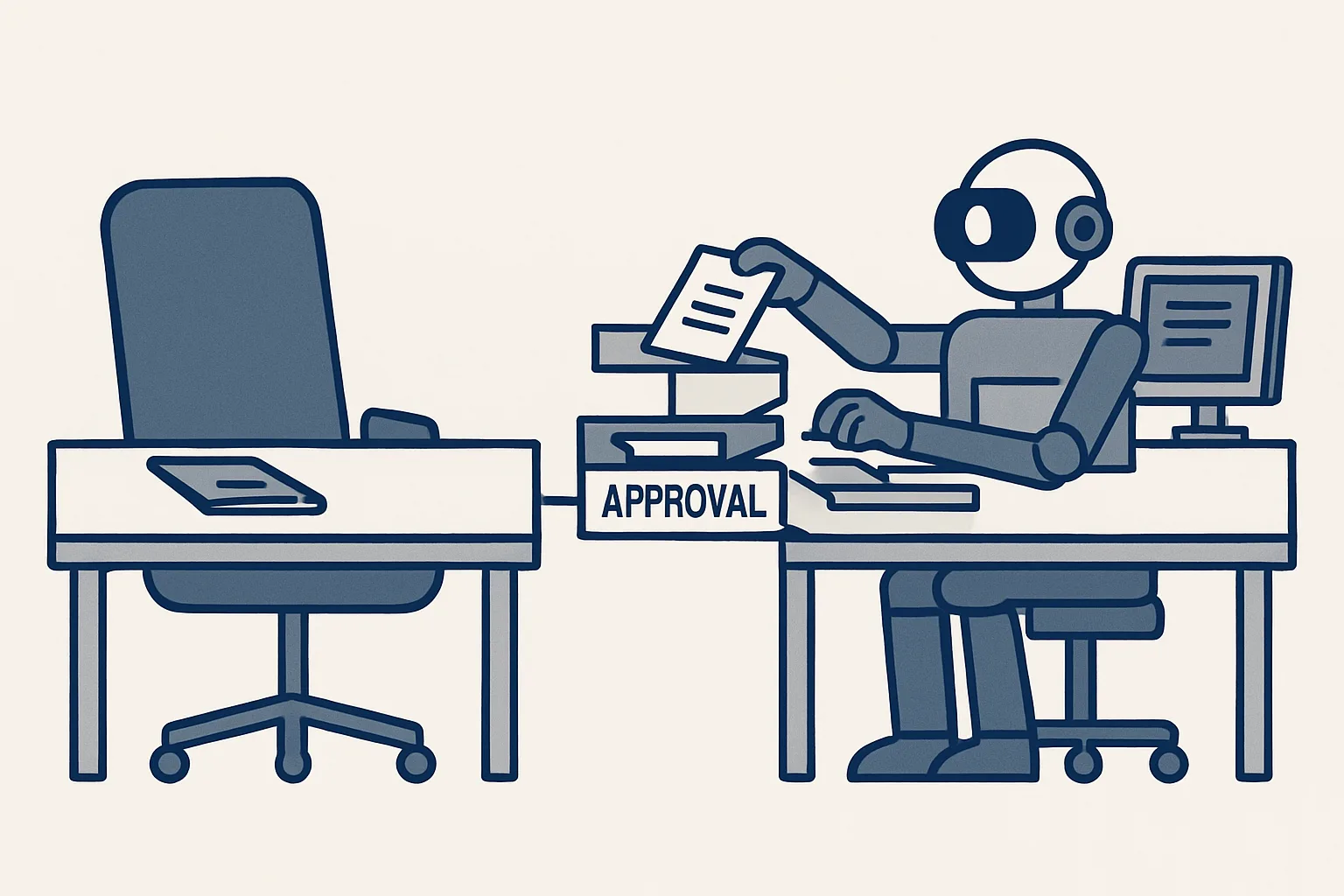
In practice the two work as a pair: the AI employee prepares the routine work as drafts, and a person checks, decides and signs.
Take sales invoicing at a small wholesale business. The person who runs sales marks an order ready in a sheet. The AI employee prepares the invoice, renders the PDF, files it and leaves a draft invoice and a draft email waiting. The person reads both, corrects anything odd and sends. The robot did the typing; the person did the judging.
The impact of AI on employees, in this arrangement, is a change in what fills the day. Less copying between systems, fewer evenings spent filing, more time on the parts of the job that need a person. The hand-offs between the two follow a fixed pattern.
The pairing also changes what a new hire is hired for. When the routine paperwork is already prepared, a new person can be brought in for the work that grows the business, such as looking after customers, managing suppliers or running projects, rather than to keep up with typing. AI employees and people end up working on different layers of the same job.
- Something happens in the business: an email arrives, a file is dropped, a row is marked ready.
- The AI employee reads it and applies the rules it was given.
- It prepares a draft, files what needs filing and writes the action to the log.
- Anything it cannot do exactly is passed to a named person with the document attached.
- A person checks the draft, decides and signs.
- The draft becomes the sent email, the posted entry or the payment.
Control, mistakes and responsibility
Responsibility always stays with people: AI employees produce drafts, a person signs, and every action is recorded so mistakes can be traced and fixed.
Any system makes mistakes, and so does any person. The difference lies in how mistakes are caught. A draft that waits for a person's check is caught before it leaves the company. A log that shows what the robot read and created makes it easy to see where an error came from.
Ours run under fixed rules. Nothing is created or changed without the owner's yes. Every result is a draft in your own systems, filed where it belongs. Anything the robot cannot do exactly goes to a person instead of being guessed. One command stops any robot at once.
New hires need control too, of a different kind: training, supervision, clear responsibilities. Neither arrangement removes the need for someone to own the result. The point of drafts and records is to make that ownership easy to exercise.
Making the decision for your business
Decide task by task: list the routine work, sort each task by whether it needs judgement, and measure the hours the routine part takes by your own count.
A simple exercise helps. Ask the team to list everything they did last week, then mark each task as routine, judgement or both. The routine tasks with the most hours behind them are where AI employees fit first. The judgement tasks are the ones to protect, and perhaps the ones to hire for.
AI employees for business are not a substitute for a team, and a new hire is not the only answer to a busy month. Many businesses find the honest answer is both: an AI employee for the routine typing and filing, and people for the work that needs them. The checklist on this page helps you sort one task at a time.
Cost works differently, too. A person is paid for their time across everything they do. Ours are rented monthly, one figure per workflow, stated in the quote, based on the hours the job takes from your routine and how complex it is. They run on our servers against your own accounts; if the rental stops, the workflow stops and every document stays yours.
Whatever you decide, start with one task, measure it in hours by your own rule and keep the decision with the people who run the business.
Questions
Are AI employees better than hiring?
They suit different work. AI employees suit repetitive, rule-based jobs with clear inputs; new hires suit judgement, relationships and anything new. Most businesses use both.
Will AI employees replace human workers?
That is not how ours are framed or used. They take typing, filing and copying between systems out of a job; checking, deciding and signing stay with people.
What is a digital worker?
Another name for an AI employee: software with one job description, started by something that happens in the business, which prepares drafts for a person to check.
What is the impact of AI on employees?
Where it is used for routine work, the main change is in what fills the day: less copying and filing, more time on work that needs a person. The decisions and the responsibility stay with people.
How much does an AI employee cost compared with a hire?
They are priced differently. Ours are rented: one monthly figure per workflow, stated in the quote, based on the hours the job takes and its complexity. Compare by the hours of routine work, not by headcount.
Want hours back from this work?
Write to [email protected] with the routine task your team would most like to hand over and the hours it takes each month. We will tell you plainly whether it fits.
Talk to us Related service: Services