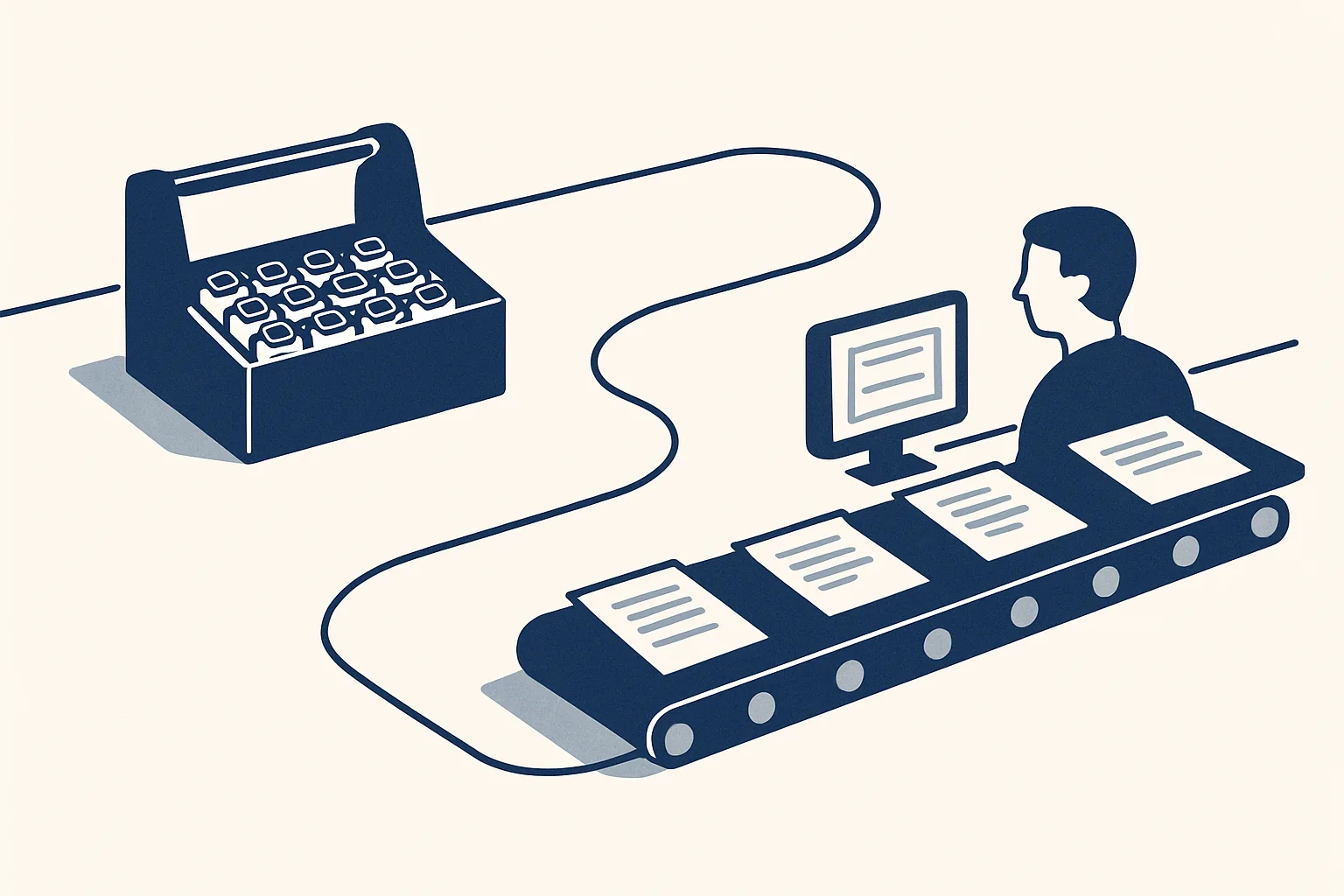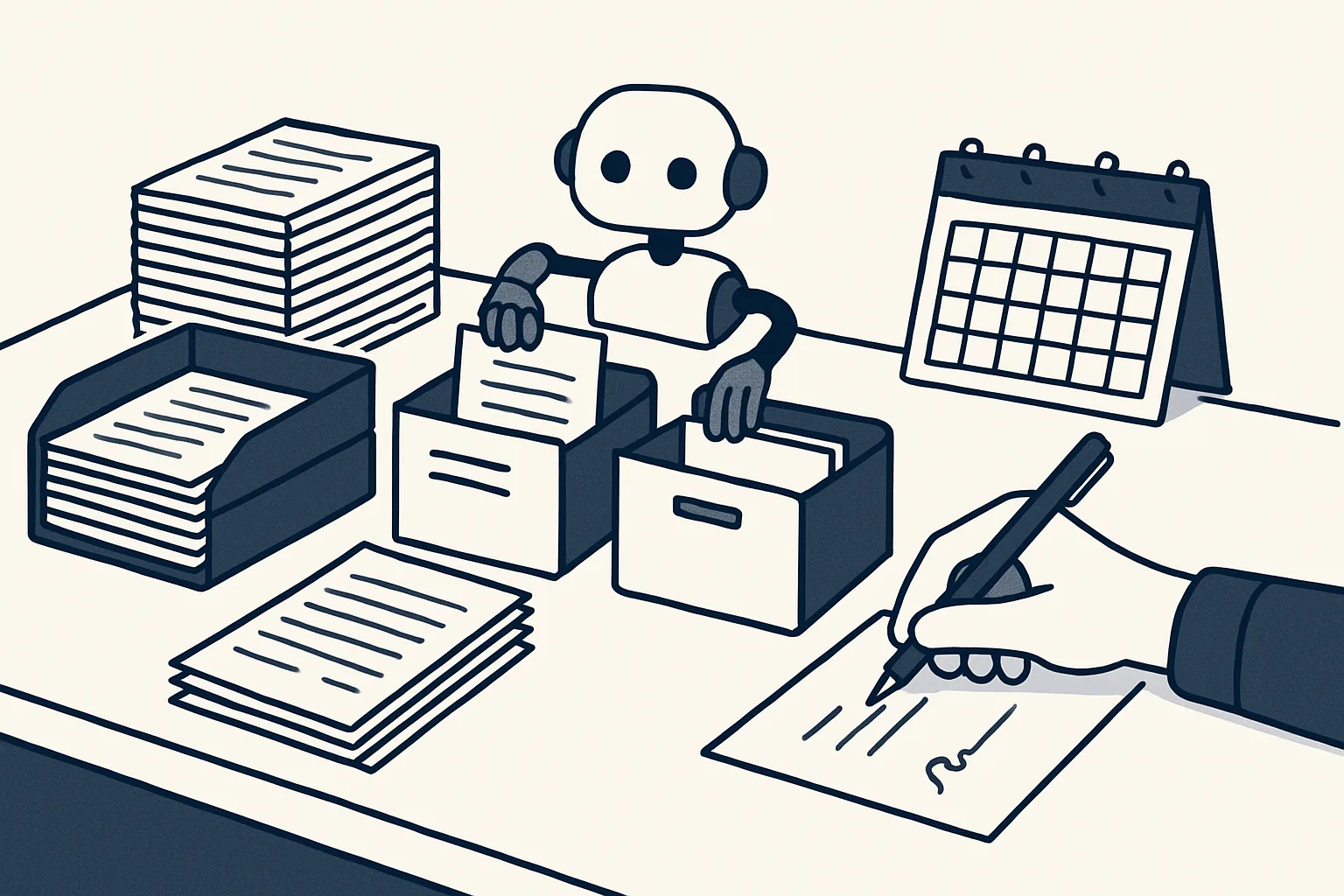
AI for law firms is safest on the administrative side: collecting and checking new-client documents, sorting the inbox by matter, drafting routine correspondence for a lawyer to review, filing, and reminders for dates. Legal analysis and advice remain the lawyer's.
Admin that eats billable time
AI for law firms is most useful on the administrative work around each matter, the part that takes hours but needs no legal judgment.
Every firm knows the list. Chasing a new client for identity documents. Checking that the documents that arrived are the right ones and still valid. Saving attachments into the right matter folder. Finding the email where a client confirmed an instruction. Preparing the engagement letter from the template and getting it signed. Remembering the date something is due back.
None of that is legal work, yet much of it lands on lawyers, paralegals and assistants whose time is better spent elsewhere. That is the honest case for automation for law firms: not a robot lawyer, but fewer hours spent on paperwork that follows the same steps every time.
The table shows where the line usually falls. The left column is work an AI employee can prepare as a draft; the right column stays with people.
A useful way to judge any offer of AI for law firms is to ask, for each task, who carries the responsibility if it goes wrong. Where the answer is the lawyer, the task stays with the lawyer. Where the answer is simply that a document was filed in the wrong place or a reminder was late, a robot that drafts and flags can take the routine off people's desks.
| Task | Can be drafted or prepared by AI | Stays with a person |
|---|---|---|
| New-client intake | Request list sent as a draft, documents collected, gaps and expiry dates flagged | Deciding to take the client on |
| Incoming mail | Sorted by matter, attachments filed, a daily list of what is unanswered | Reading what matters and replying |
| Routine letters | Drafts from the firm's own templates and past letters | Checking, signing and sending |
| Engagement letters | Prepared from the template, signed online by the client | The terms and the decision to send |
| Dates | Listed on the matter register from documents and emails | What the date means for the case |
| Advice and analysis | Nothing | All of it |
New-client intake and documents
Intake is the best first job for AI for law firms: the documents a new client must provide are requested by draft email, collected, checked for gaps and expiry, and filed with a register row.
Law firm document automation often starts here because the job is the same for every new client, and because a missing document can hold up a matter for weeks. The robot does not decide what the firm requires. The firm writes its own list once, per type of client or matter, and the robot works from it.
This is offered and built to order, on the same engine as our client and supplier onboarding. Here is how a new instruction moves through it.
A register row per new client is the heart of it. Each requested item is a column; each column shows received, missing or expired. A partner who wants to know why a matter has not started can open one sheet instead of asking three people.
- A person opens the new matter on the register and chooses the client type.
- The robot prepares a draft email to the client with the firm's own request list for that type.
- A person checks the draft and sends it.
- As documents arrive by email or upload, the robot files each one in the matter folder and ticks it off the register row.
- It flags what is still missing, what is unreadable and what has an expiry date that has passed or is close.
- When something is overdue, it prepares a draft reminder for a person to send.
- A person reviews the complete file and approves the new client record.
The inbox sorted by matter
Incoming mail can be read, matched to the right matter and filed, so each matter's correspondence is in one place without anyone dragging emails into folders.
Legal workflow automation in the inbox is mostly about finding things later. The robot reads the sender, the subject, any reference numbers and the attachments, and matches the email to a matter on the register. Attachments are saved to the matter folder. Emails it cannot match go to a person rather than into a guess.
One part of this runs today for clients: a morning digest of the previous day's new and unanswered emails across several mailboxes, sorted by business, each with a short gist and the full text one tap away. Sorting by matter and drafting routine replies from the firm's own past letters are offered and built to order.
For AI for lawyers working alone or in small teams, this is often where the most hours come back. Nobody has to remember which emails are still waiting for an answer; the list is there each morning.
Matching mail to matters works best when the firm already uses a reference in subject lines or on its letters. Where it does not, the robot falls back on the client's name and the parties on the register, and anything ambiguous is passed to a person. Over time, the share of emails that need a person shrinks as the register fills in.
Build your intake request list
Tick each document or detail your firm asks a new client for. Print the page: the ticked items are your request list, and each one becomes a column on your intake register.
Engagement letters signed online
Engagement letters can be prepared from the firm's template and signed online, with a record of who signed, when and which exact version.
Our online signing page runs today. The document becomes a private web page. Each party signs with a drawn signature, a typed name and a consent line. A signature record in PDF shows who signed, when, and a fingerprint of the exact document, so any later change shows. No outside signature service is involved.
The same page works for other routine signatures around a matter: a client's confirmation of instructions, a fee estimate the client accepts, or an authority the client gives the firm. In each case the robot prepares, a person checks, and the client signs.
Whether an online signature suits a given document is a question for the firm and its own rules; we do not advise on that. What the page gives is a clean route from a draft letter to a signed copy filed on the matter.
What AI for law firms should not do
AI should not give advice, review contracts for legal effect, decide on a client or send anything on the firm's behalf.
These limits are deliberate. Any use of AI for law firms that drifts into legal analysis moves responsibility onto software that cannot carry it. Ours is built so that the robot only produces drafts, nothing is ever sent by a robot, and every action is written to an audit record.
In practice, that means the list of things it does not do is as important as the list of things it does.
- No legal advice and no legal analysis of documents.
- No contract review for meaning, risk or enforceability.
- No decision to accept a client or a matter.
- No email, letter or filing sent without a person pressing send.
- No court or registry filings made on its own.
- No movement of money, including client funds.
Confidentiality and access
The robot works inside the firm's own mailboxes, folders and sheets, with only the access the firm grants, and the firm can withdraw it at any time.
Our AI employees are rented monthly and run on our servers against the client's own accounts. Documents stay in the firm's folders, emails in the firm's mailbox and registers in the firm's own sheet. Nothing is copied into a separate system that the firm would have to trust separately.
Access is limited to what the job needs: the intake mailbox and the matter folders, for example, not every account in the firm. A kill switch stops any robot in one command, and nothing is switched on without the firm's yes.
When firms weigh AI for law firms against doing nothing, the question is rarely the software. It is whether the firm can say exactly which mailbox, which folders and which job the robot may touch. If that can be written on one page, access can be granted narrowly and reviewed.
Your professional rules on confidentiality and outside providers still apply, and the firm should check them with its own regulator or adviser before any automation touches client files. AI for law firms has to fit inside those rules, not around them.
Questions
Can AI replace a paralegal or legal assistant?
Not ours. It takes typing, filing and chasing out of the routine. Checking, judgment, client contact and anything legal stay with people.
Is it safe to use AI on client files?
That depends on your professional rules and on how the tool is set up. Ours works inside the firm's own accounts with limited access and an audit record; check your obligations with your regulator or adviser first.
Can AI draft letters for lawyers?
It can prepare routine drafts from the firm's own templates and past letters. A lawyer checks, edits and sends them. Ours never sends anything itself.
Does it review contracts?
No. We do not offer contract review or legal analysis. The work is administrative: intake, mail, filing, routine drafts and signing.
What is the first job to automate in a small firm?
Usually new-client intake, because it repeats for every client and follows a list. The checklist above turns your own list into a request list and register columns.
Want hours back from this work?
Write to [email protected] with the admin job that takes your firm the most hours each month, and we will tell you plainly whether it can be drafted for a person to check.
Talk to us Related service: Client and supplier onboarding