A good cold email follow up is short, comes a few days after the first email and adds one useful thing. Most replies come after a follow up, so one email is rarely enough. Stop after a few tries, or at once if someone says no.
Why does a cold email follow up matter?
A cold email follow up matters because most people don't answer the first email, even when they'd be glad to hear from you.
Say a small cleaning company emails a local office manager. The manager reads it on a busy Tuesday, thinks "later" and forgets. It wasn't a no. It was bad timing. A friendly nudge a few days later often catches them on a quieter day.
That is all a follow up is: a polite reminder that arrives at a better moment. It isn't pushy if it's short, useful and easy to refuse.
Think of the follow up as part of the first email, not a second attempt. You are telling one story in short pieces, and each piece should make sense on its own.
The mistake most people make is the opposite. They send one email, hear nothing and decide the idea failed.
How often should you follow up?
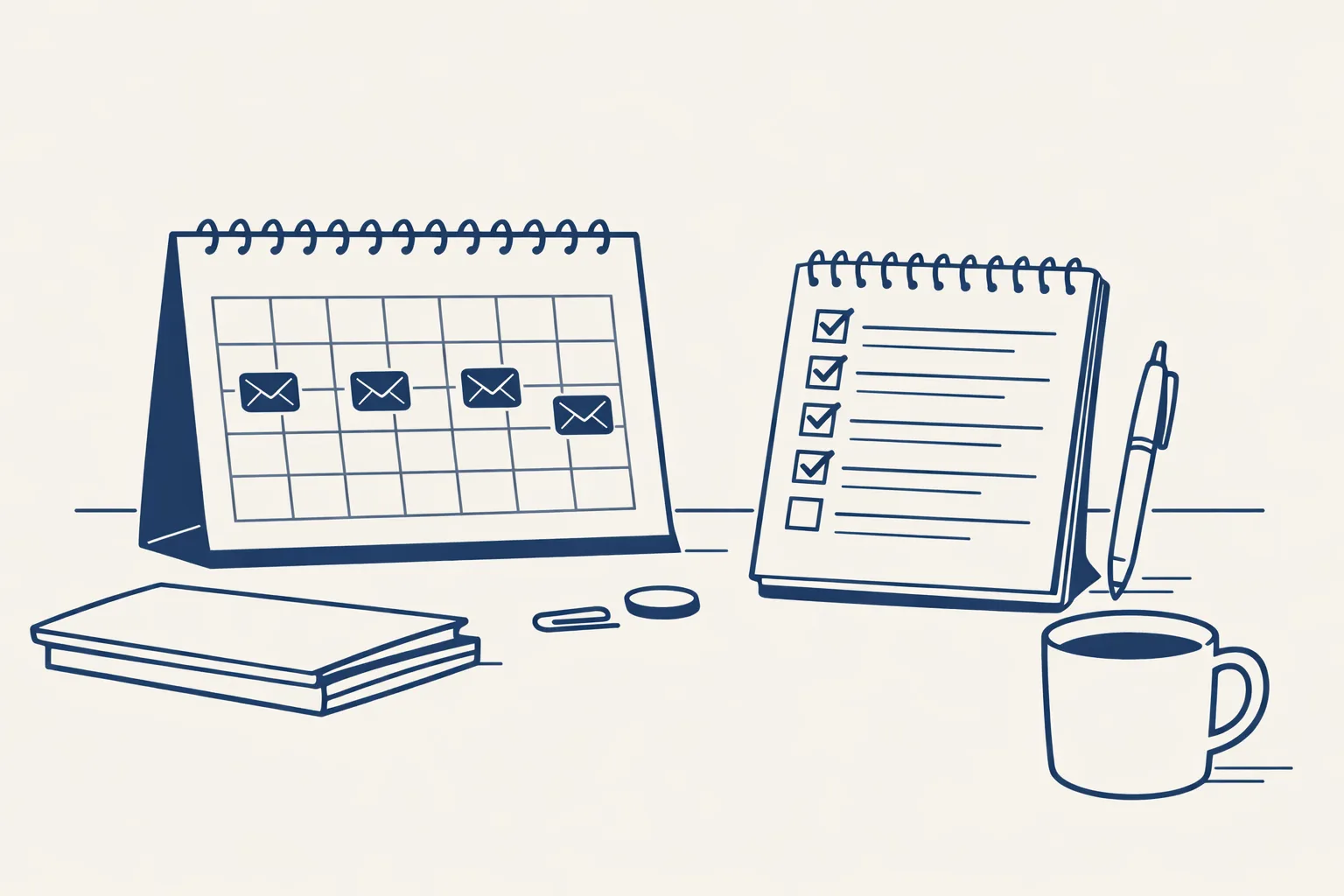
Leave a few days after the first email, then widen the gaps: a few days, about a week, then longer.
A simple rhythm keeps you honest. Early on, a short gap is fine because the first email is still fresh. Later, give people more room. Nobody wants a message every day.
Timing matters a little. Mail that lands on a Monday morning is often buried by the weekend's pile, and mail on a Friday afternoon is forgotten. Midweek, mid-morning tends to be calmer. Test it on your own list rather than trusting anyone's rule.
Here is a common rhythm, in plain words:
| When it goes | What it does | |
|---|---|---|
| First email | Day one | Says who you are and why you wrote |
| First follow up | A few days later | A short reminder with one new point |
| Second follow up | About a week after that | A useful example or a simple question |
| Third follow up | Two weeks or so later | A different angle |
| Last note | A couple of weeks after that | A polite goodbye and an open door |
What should you say in a follow up?
Say something new and keep it short: a reminder that is just "checking in" gives the reader nothing.
A bookkeeper emailing a shop owner could follow up with: "Last week I wrote about tidying your month-end. One tip that helps most shops: match each receipt to its bill the same day." That gives a small gift and still points back to the first email.
Avoid the guilt-trip follow up, the one that says "I haven't heard back". It puts the weight on the reader. Give them something instead, and the reply feels easier.
Good follow ups tend to do one of these things:
- Add a small tip the reader can use even if they never reply.
- Share a short example of a similar business and what changed.
- Ask one easy question that needs only a yes or no.
- Offer a clear next step, like a short call or a quick look.
- Say goodbye politely if there's still no answer.
How many hours do your follow ups take?
Type in your own numbers. The result is the time you spend on outreach emails each month, by your own count. It's not a promise of what anyone would save.
What does a good follow up look like?
A good follow up fits on a phone screen and has one point, one question and one polite line at the end.
Here is a plain example for a trade supplier writing to a restaurant owner:
"Hello, I wrote a few days ago about delivering fresh herbs twice a week. In case it got buried: would a small sample box be useful to try? If this isn't of interest, just say so and I won't write again."
Notice what it does. It's short. It points back to the first email. It gives an easy way to say yes, and an easy way to say no. Always keep the opt-out line, and check the rules in your own country about unsolicited email.
Keep the subject line the same in a follow up, with the usual "Re:" so it stays in the thread. A fresh subject line can look like a new, unrelated email, and the history is lost.
When should you stop?
Stop when someone replies, bounces or says no. Stop after the last note if there's silence.
Picture a florist who keeps writing to a man who said "not now" two weeks ago. The next email costs her a customer for life. A polite stop keeps the door open for later.
Be honest with yourself about the quiet ones too. Someone who never answers is also an answer. After the last note, move on, and let your next list get the energy.
Here is a simple routine to follow:
- Send the first email and write the date in your sheet.
- Set the date of the next follow up before you close the sheet.
- Send each follow up in the same thread, so the history is there.
- Mark the row at once if someone replies, asks to stop or the email bounces.
- Stop all follow ups for that person right away.
- After the last note, leave the row alone for a good while.
Where do we fit, and how long does this take by hand?
Doing this by hand takes real time, because you need to remember who is due for what. The calculator below shows the hours.
On our own brand, lead lists are built only from public business sources, one recipient gets one email, every email has an opt-out line, follow ups go out on a fixed rhythm, and the robot stops on a reply, a bounce or a "no thanks". For your business, the same set-up is built to order.
Every step starts with your approval, then you choose when it goes automatic.
Questions
How many times should I follow up a cold email?
Often three or four times over a few weeks, with growing gaps. Stop at once if someone says no.
How long should I wait between follow ups?
A few days after the first email, then about a week, then longer. Nobody wants daily messages.
What should a follow up say?
Something short and new: a tip, a small example or one easy question. Avoid just "checking in".
Should I reply in the same thread?
Yes. The reader sees your first email and the new one together.
Is it okay to follow up at all?
Yes, if it's polite, short and easy to refuse. Always include a way to opt out, and check your local rules.
Tell us your workflow. We will build it around you.
Tell us how many people you contact each month. Write to hello@thenewaiemployee.com and we'll say honestly whether a steady follow up rhythm fits you.
Talk to us Related service: Lead lists and outreach