To hire an AI employee, pick one well-defined job, show how it is done today, agree what the robot may draft and what a person must approve, then switch it on for real work with every action logged. Pricing is usually one monthly fee per job, based on the hours it takes off your routine and how complex the job is.
Choose the first job
The first step when you hire an AI employee is to choose one job that repeats often, follows rules you can write down and ends in a document, an entry or an email.
An AI employee is an automation with one written job description, carried out inside the tools your business already uses. Some providers call it an AI agent employee, others a digital worker. The name matters less than the scope: one job, a clear start, a clear finish and a person who signs off at the end.
Businesses that hire AI employees successfully rarely start with the biggest problem. They start with the most repetitive one. Think of the jobs someone in your office does the same way every week: entering supplier bills, preparing sales invoices, filing documents into the right folder, rendering purchase orders, sorting the morning's mail.
A good first job has three traits. The work arrives in a predictable place, such as a mailbox, a folder or a sheet. The steps are the same each time. And a person can check the result faster than doing the job by hand. Jobs built on a negotiation, a relationship or a judgement call are poor first candidates, however often they happen.
The table compares a few common office jobs on those traits. It is a starting point for your own list, not a ranking.
| Job | Where the work arrives | Ends in | Fit as a first job |
|---|---|---|---|
| Supplier bills | Mailbox or a drop folder | A draft bill with the PDF attached | Strong: same steps, easy to check |
| Sales invoices | A row marked ready in a sheet | A draft invoice and a draft email | Strong: rules can be written down |
| Purchase orders | A row in a sheet | An order PDF and a draft email | Strong: one row, one document |
| Morning mail summary | Several mailboxes | One digest sorted by business | Good: saves reading time, decides nothing |
| Price negotiation | Phone calls and meetings | An agreement | Poor: judgement and relationship |
| Hiring decisions | Interviews | A decision | Poor: keep with people |
Describe how it is done today
Before anything is built, show the provider how the job is really done today, using real examples rather than a summary from memory.
Memory tidies things up. The person who does the job will describe the normal case and forget the credit note that arrives once a month, the supplier who sends invoices as photos, or the colleague who forwards documents from a personal mailbox. Those exceptions are exactly what a robot needs to know about, because they are where mistakes happen.
A useful description covers the whole route of the work. Write it the way you would brief a new starter, and attach real documents wherever you can.
- Name the job in one line, for example: enter every supplier bill as a draft in the accounting system.
- List where the work arrives: which mailboxes, folders or sheets, and who forwards what.
- Collect a handful of real examples, including at least one awkward case.
- Write the steps a person follows today, in order, and the rules behind each decision.
- Note which systems are touched: the mailbox, the folders, the sheets, the accounting system.
- Say where the finished result goes and who checks it.
- Count how often the job happens each month and how long one case takes, by your own rule.
Agree what is drafted and what is approved
The most important agreement when you hire an AI employee is the line between what the robot prepares and what a person must approve.
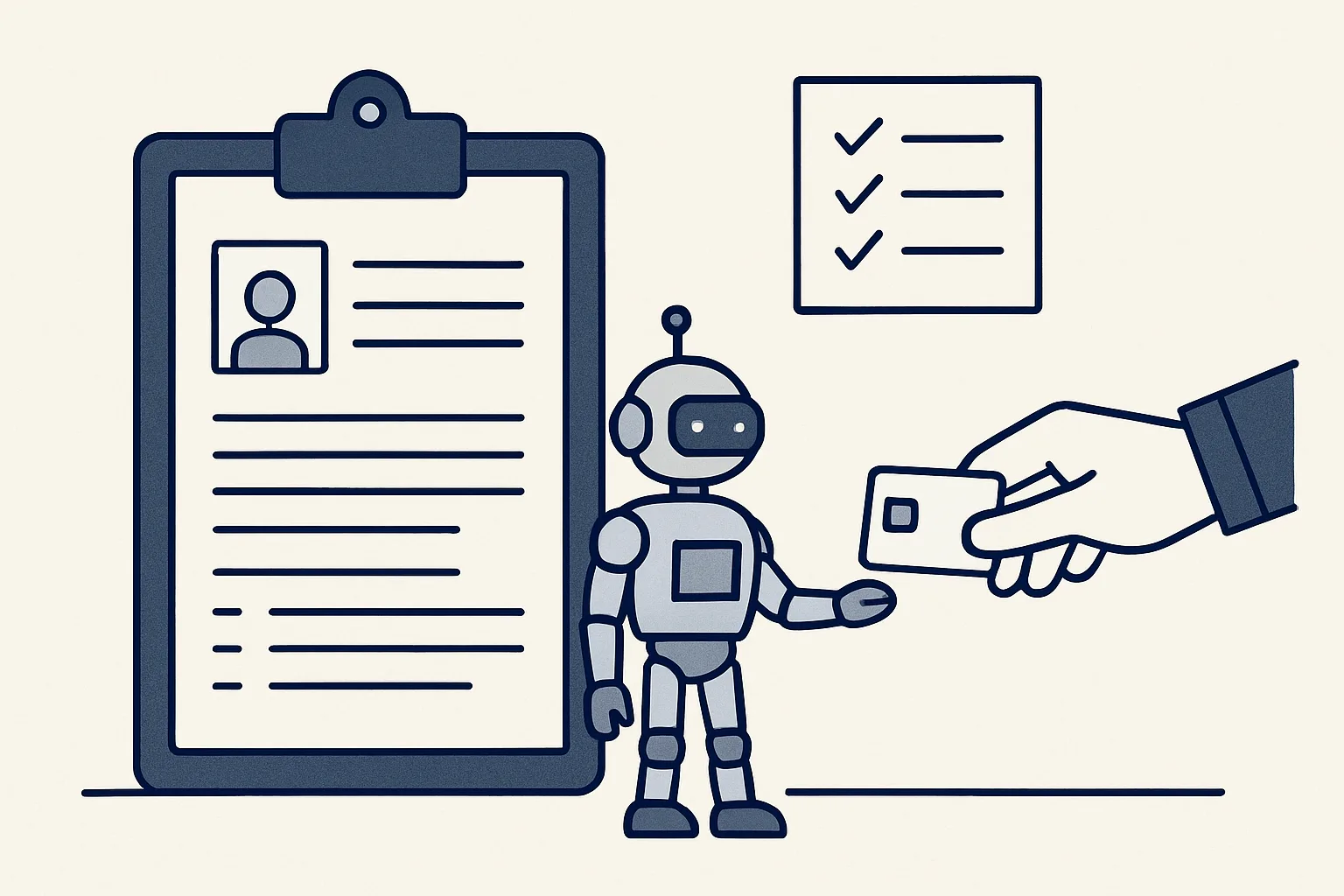
A sound arrangement keeps every decision that matters with people. The robot reads, types, files and prepares drafts. A person checks the drafts and signs anything that leaves the company: an email, an invoice, a bill, a payment. The robot never sends anything by itself and never moves money.
Ours run under that rule. Nothing is created or changed without the owner's yes, the robots only produce drafts, nothing is ever sent by a robot, every action is written to an audit record and a kill switch stops any robot in one command.
Agree the exceptions in writing too. Anything the robot cannot do exactly, such as an unknown supplier, a refund or a document that does not add up, should go to a named person instead of being guessed. Agree who that person is, how they are told and what happens to the document while it waits.
- Drafted by the robot: entries, documents, filed PDFs, draft emails, register rows, notifications.
- Approved by a person: anything sent, anything posted as final, any payment, any new supplier or client record.
- Passed to a person: every case the robot cannot handle exactly, with the document attached.
- Recorded for everyone: every action, in an audit record you can read.
Is your brief ready to send to a provider?
Write a one-page brief for the job you want to hand over. Tick each part it already covers; the gaps are what to add before you send it to anyone.
Questions to ask any provider
Ask any provider of AI employees for business where the robot runs, what it can touch, what it does when it is unsure and what happens when you stop paying.
An AI automation service can look impressive in a demonstration and still be hard to live with. The answers to a few plain questions tell you how it will behave on an ordinary Tuesday, when a strange document arrives and nobody is watching.
Good answers are specific. If a provider cannot say what happens to an unclear document, or who owns the data, treat that as the answer.
- Does it work inside our own mailbox, folders and accounting system, or does our data move somewhere else?
- What exactly can it create, change or delete, and can that access be limited?
- Does it ever send an email, post an entry as final or pay anything without a person?
- What does it do with a case it cannot handle exactly?
- Is every action written to a record we can read?
- How do we stop it, and how quickly?
- Who looks after it when our suppliers, templates or rules change?
- If we stop, what do we keep, and what has to be exported?
- How is the price set, and what makes it change?
How pricing usually works
Most providers price an AI employee as a monthly fee per job, set by the hours it takes off your routine and by how complex the automation is.
Ours are rented, never sold. We build them, run them on our servers against your own accounts and look after them; you pay one monthly figure per workflow, stated in the quote. There is no one-off purchase and no software for you to install or maintain.
Two things move the figure. The first is the hours the job takes from your week, measured by your own rule, such as the minutes one invoice takes multiplied by the number of invoices. The second is complexity. A simple job is built quickly and is live at once. A job that needs several AI employees working together, for example reading a document, checking it against a register and preparing two different drafts, takes longer to build and to look after.
If the rental stops, the workflow stops. Because everything was always kept in your own mailbox, folders, sheets and accounting system, nothing has to be handed back.
We do not promise a saving. The measure we talk about is the hours your own count says the job takes today.
The first weeks after switch-on
In the first weeks after switch-on, check every draft closely, keep a list of the cases that went to a person, and adjust the rules before widening the job.
How long the build takes depends on the work: simple tasks are live at once, complex ones take longer. Either way, the robot is switched on only with your yes, and the first real cases deserve a careful look. Check the drafts the way you would check a new colleague's work: line by line at first, then by sample once you trust the pattern.
Expect some cases to be passed to a person in the early weeks. That is the system doing its job, not failing at it. Each one is a chance to write a clearer rule, add a supplier template or decide that a certain kind of document should always stay with people.
Communication matters as much as the robot. Our clients talk to us through a private app where each task has a space for the AI, for the client and for our team; messages and voice notes are kept in the client's own sheet. When something looks wrong, it is raised there and answered there, with the history kept.
Once the first job runs smoothly, the second one is easier to brief. Most businesses add jobs one at a time, each with its own description, its own approvals and its own measure in hours.
Questions
Can you hire an AI employee?
Yes, in the sense of renting an automation that does one named job inside your own accounts. It is not a person: it prepares drafts and records every step, and a person checks and signs anything that leaves the company.
How much does it cost to hire an AI employee?
Ours are rented: one monthly figure per workflow, stated in the quote. It depends on the hours the job takes from your routine and on how complex the automation is. There is no one-off sale.
How long does it take to set up?
It depends on the work. Simple tasks are live at once; complex ones, where several AI employees work together, take longer.
What is an AI agent employee?
It is another name for an AI employee: software given one job description, triggered by something that happens in the business, such as an email or a row marked ready, which carries the job through to a draft.
What happens to our data if we stop?
The workflow stops, and everything stays where it always was: your mailbox, your folders, your sheets and your accounting records. Nothing has to be exported or handed back.
Want hours back from this work?
Write to [email protected] with the job you want to hand over and the hours it takes you each month, and we will tell you plainly whether it fits.
Talk to us Related service: Services