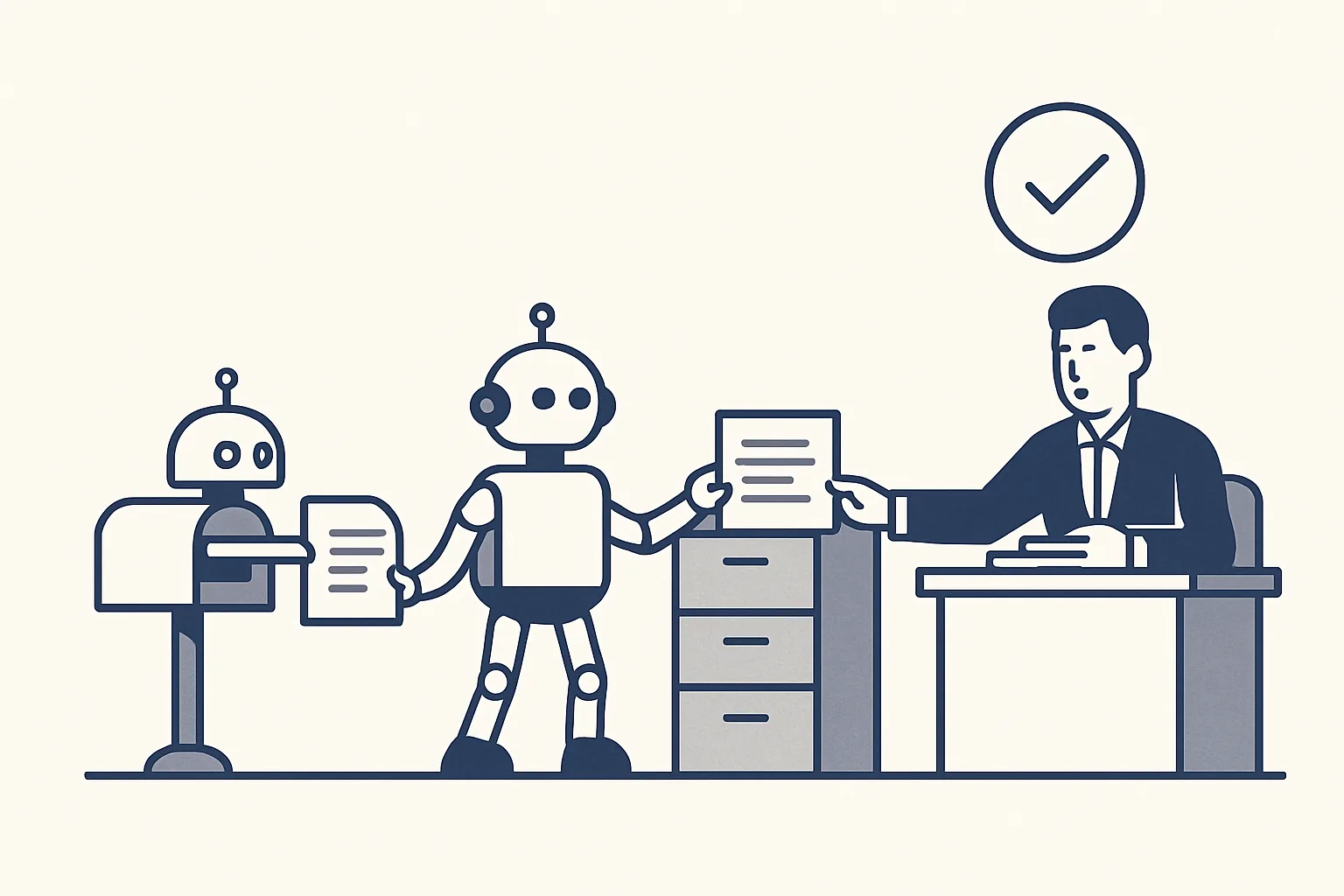
Multi agent systems split a big job between several AI helpers, each with one narrow task, who pass the work along. One reads the mailbox, one enters bills, one files documents. They suit jobs too broad for one automation, as long as every handoff has clear rules and one person owns the result.
What are multi agent systems, in plain words?
Multi agent systems are a team of small AI helpers, each with one narrow job, who hand work to each other until the whole job is done.
Think of a bakery. One person takes the orders, one bakes, one packs, one sends the invoice. Nobody does everything, and everybody knows what they pass on. A multi-agent system works the same way, with software helpers in place of people.
An "agent" here is just a piece of software. It takes something in, decides what to do within limits it was given, and hands something on: a draft, an entry, a file, a message to the next helper.
You'll hear "multi agent AI" in a lot of product announcements, often loosely. The useful questions for you are simpler: does splitting the job help, where can it go wrong, and who is accountable?
Why split a job between helpers?
Split a job when its parts need different skills, different rules or different timing, so each part can be built, tested and fixed on its own.
One big automation gets hard to understand. When something breaks, nobody knows which part failed. When one rule changes, the whole thing has to be tested again. Businesses split work between people for the same reason. The person who opens the post isn't the one who approves payments.
The practical gains:
- Each helper has one narrow job, so its rules can be written down and checked.
- A failure shows up at a specific handoff, not inside a black box.
- You can improve or replace one helper without rebuilding the rest.
- Helpers can run at different times: one every few minutes, another once a day.
- Access can be limited. The helper that reads the mailbox doesn't need to touch the accounts.
- The last check stays in one place, with one named owner.
What does it look like in a real office?
Supplier bills are a good example: one helper watches the mailbox, one reads and enters bills, one files the papers, and one tells a person what needs a decision.
Our supplier bills robot, running today for a client, works along these lines. Say a supplier emails an invoice. It's picked up, read, entered as a draft bill in the accounting system with the PDF attached, filed under the supplier, and you get one message about it. Each of those is a separate role with a handoff in between.
Notice that only the reader needs real AI skill, and only for layouts it hasn't seen before. The others follow fixed rules. That's typical of good multi agent architecture for office work. The AI does the hard reading, and plain rules carry everything that can be written down, because rules give the same answer every time.
Here are the roles and where each one stops and asks for help.
| Helper | Its one job | It stops and asks a person when |
|---|---|---|
| Mailbox watcher | Spots new emails and files that may be supplier papers | Nothing new has arrived |
| Document reader | Decides invoice or credit note, and reads supplier, date, number, amounts | It's unreadable, a refund, or an unknown supplier |
| Bill writer | Creates the draft bill with the PDF attached | The number is a duplicate or the totals don't add up |
| Filer | Saves the PDF under the supplier | The folder is missing |
| Notifier | Sends one message per bill, with anything waiting for a decision | Never. A person always gets the result |
Does your job need more than one helper?
Pick a job you want to automate and tick what's true. The more you tick, the more likely it needs several helpers with clear handoffs.
Where do things go wrong?
Most failures happen at the handoffs, so each handoff needs a written rule for what passes, what gets checked and what happens when the check fails.
Three things can go wrong when one helper passes work on. The work can look right and be wrong, so the next helper builds on a mistake. It can be incomplete, so the next one guesses the missing part. Or two helpers can work from different versions of the facts. Inside one big automation these problems hide. In a team of helpers they sit at visible joins, which only helps if the joins are guarded.
Guarding a handoff means fixed checks: the totals must add up, the supplier must already exist, the invoice number must not be entered twice. If a check fails, the work stops and goes to a person. That's the rule in the bills robot we run. A new supplier is added only after you say yes.
Here's how to design the handoffs for any split job.
- List the parts of the job and give each to one helper with one written job description.
- For each handoff, write down what is passed on and in what form.
- Write the checks the receiving helper runs before it accepts the work.
- Decide what happens when a check fails. Usually the work goes to a person.
- Record every handoff in a log, so any result can be traced back.
- Put one person's approval at the end at first, and move it to automatic once the output has proven itself.
Do more helpers mean more cost?
Yes. Several helpers cost more to design, test and run than one, so use a team only when the job truly needs it.
Every extra helper adds a handoff to plan, checks to write and behavior to watch. Simple jobs, like filing invoices by month or sending a morning list of unanswered emails, need one automation, not a team. A broad job that crosses the mailbox, the accounting system, the folders and a register is where splitting pays off.
Our AI employees are rented monthly and run on our servers against your own accounts. You pay one monthly figure per workflow, stated in the quote. It's based on the hours the work takes out of your routine and on how complex it is. Complex jobs need several AI employees working together. Simple ones are built quickly.
Be wary of designs with lots of helpers for their own sake. More helpers can mean more places for a small error to grow, not more intelligence.
Who stays in charge?
However many helpers a job uses, one named person owns the final result, and every helper stops at a finished draft with its record.
Spreading a job across helpers can blur who's responsible. It's tempting to say "the system did it". But the business is still responsible. In practice one person needs to own each workflow: they check the drafts, deal with the cases passed to them, and decide when a rule should change.
Give that person one view of what's waiting for them. In our client app every task shows what's waiting for whom, and it can be marked done or reopened. Whether the work passed through one helper or five, the person sees one list.
The controls are the same for one helper or many. Every step starts with your approval, inside your own accounts, and every action goes in a log. One command stops any robot. If a supplier of agent systems can't tell you who checks the output and how to stop it, settle that before anything else.
Questions
What are multi-agent systems in simple terms?
Several AI helpers, each with one narrow job, passing work to each other to finish a bigger job. Like a small team where each person does one part.
When do you need more than one AI agent?
When a job crosses several systems, needs different rules in different parts, or starts from different events. Simple jobs need one.
What can go wrong with multi agent AI?
Mistakes passed along, incomplete handoffs that lead to guesses, and unclear responsibility. Checks at each handoff and one person owning the end prevent most of it.
Are these systems more expensive?
Usually, because every extra helper adds design, testing and watching. That's why they suit broad jobs, not simple ones.
Who is responsible for what the system does?
The business, through one named person who owns the result and can stop it at any time.
Tell us your workflow. We will build it around you.
Tell us the job you want automated and the hours it takes each month. Write to [email protected] and we'll say plainly whether it needs one AI employee or several.
Talk to us Related service: Services