AI copywriting sounds generic when it has nothing of yours to work from. Give it a short voice kit, your real phrases and your facts, then read the result aloud. If it sounds like you, publish. If not, fix the lines that feel wrong.
Why does AI copywriting often sound like everybody else?
AI copywriting sounds like everybody else because it has read everybody else and has nothing of yours to copy.
Say a hardware store asks for a home page line. AI offers "Your one-stop shop for quality tools." It could be any store on any street. The owner, meanwhile, says "We'll find you the right screw, even if it takes all afternoon." That is the line people remember.
The difference is not talent. It is material. AI works from what it is given. Give it nothing and you get the average of everything.
Think of a small furniture workshop. Its website says "We craft bespoke solutions tailored to your needs." The owner, on the phone, says "Tell me the room and I'll tell you what will fit." The phone version wins every time. Your job is to get the phone version onto the page.
There is a second trap. AI loves big, shiny words because they are common. Words like "innovative" and "unique" appear everywhere, which means they say nothing.
The fix is simple. Give it more of you.
What goes into a voice kit?
A voice kit is a short page of notes about how you talk, what you stand for and which words you use or avoid.
A bakery's kit might say: friendly, short sentences, never fancy words, says "loaf" not "artisanal bread product", signs off with "See you in the morning." That is half a page. It changes everything the AI writes.
You do not need to invent this from scratch. Open your sent folder and read ten emails to customers. The way you naturally write there is your voice. Pick out the habits and write them down.
Keep it small and real. Here is what to put in it:
- Three words that describe how you sound, such as warm, direct, dry.
- Words and phrases you really use.
- Words you would never say, like "synergy" or "world-class".
- Two or three real emails or posts you are proud of.
- Who you are talking to, and how they speak.
- How you open and close a message.
How do you brief AI copywriting well?
You brief it by giving the voice kit, the facts and the goal in three short parts.
A tiny physio clinic wants a line for its booking page. It gives the voice kit, the facts (open six days, first visit takes forty-five minutes, no referral needed) and the goal (get a new patient to book). The result is on target the first time.
Without the kit, the same request returns "Take the first step towards a healthier you." Nobody wants to book that.
Brief it like you would brief a new employee on day one. Show examples. Say what you do not want. Give the reason behind the job.
A good brief is also short. Half a page is plenty. A long brief tends to be muddled, and the result follows.
If the first answer is off, do not start again. Say what is wrong: "Too formal. Shorter. Say 'call us' not 'contact us'." Three corrections usually do it.
Here is the routine in order.
- Write or update your voice kit.
- Collect the facts the copy needs.
- State the goal in one sentence: what should the reader do?
- Ask for two or three versions.
- Pick the closest to you and mark the lines that feel off.
- Rewrite those lines in your own words.
Is your voice ready to hand to AI?
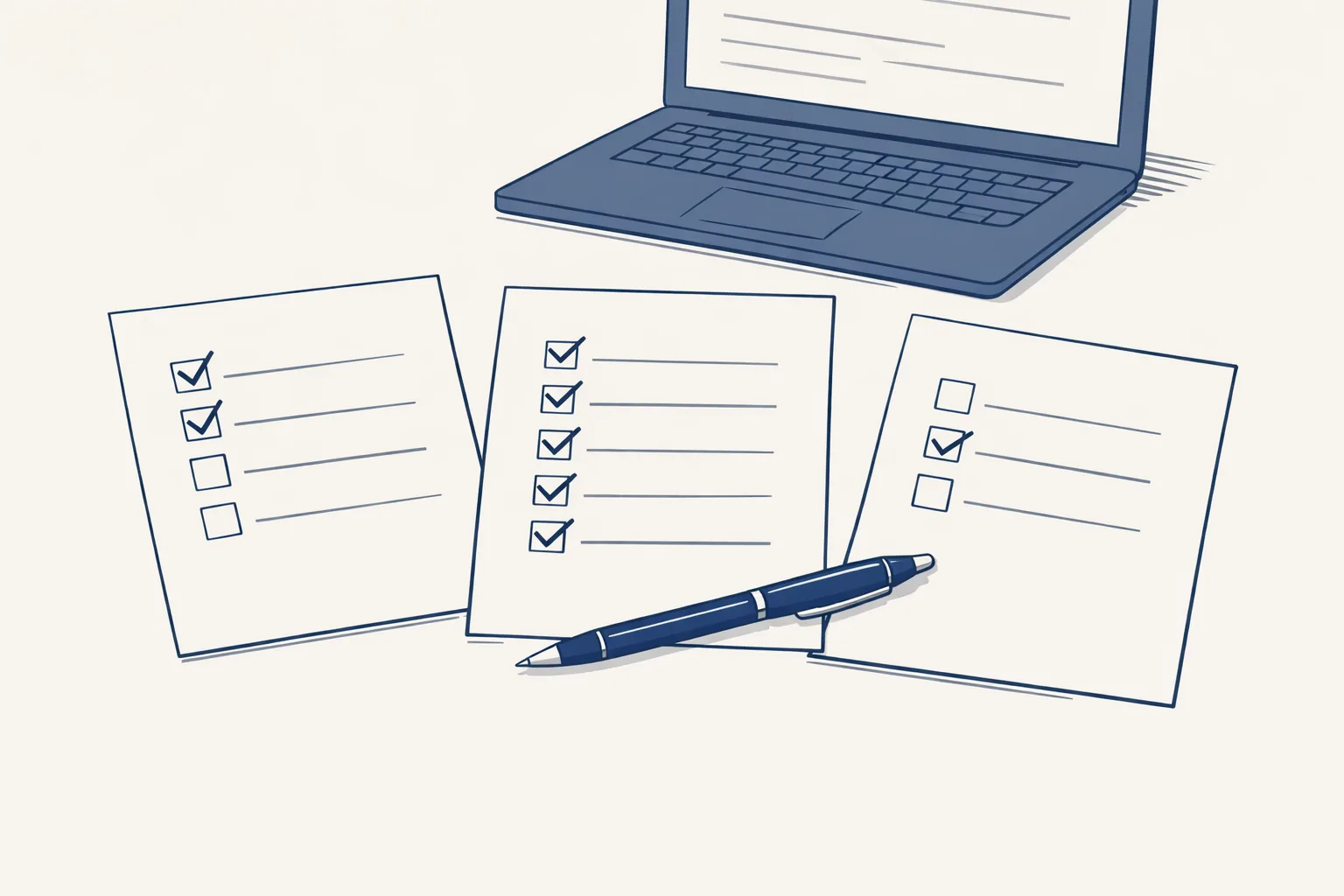
Tick each line that is true today. The more you tick, the better any AI copy will sound like you.
How do you edit AI copy until it sounds like you?
Read it aloud, and change every line you would never say.
Imagine a locksmith reading "We provide comprehensive access solutions." He laughs. He changes it to "We get you back inside, fast." That is the whole edit, and it takes ten seconds.
Do three passes. First facts: is every claim true? Then voice: would you say this out loud? Last trim: take out anything that is just there to sound important.
Here is another quick edit. A cafe's draft says "We pride ourselves on our exceptional coffee." The owner changes it to "Our coffee is strong and the cups are big." It is plainer and more believable.
We do this for the pages we write. They are written in each language as a native would write them, and you read them before they go live. That read is where the voice comes back.
When should you not use AI copywriting?
Do not lean on AI copywriting for the lines that carry your promise, your apology or your price.
A restaurant owner apologizing for a bad evening should write that note herself. People can tell. A sincere clumsy note beats a smooth empty one.
The same goes for anything personal: a welcome note to a new neighbor, a thank-you to a long-time customer, an answer to a complaint. Keep those in your own words, even if they are short.
AI is good for the structure and the tidy-up. The heart of the message is yours. Use the checklist below to see how much of your voice is ready to hand over.
Questions
What is AI copywriting?
Using AI to draft marketing and website text, such as headlines, product descriptions and emails. You give it your voice and facts, then edit.
Why does AI copy sound so generic?
It works from what it is given. Without your own words and facts, it returns the average of what it has read.
How do I make AI copy sound like me?
Write a short voice kit, give real examples, state the facts and the goal, then edit until you would say it aloud.
Can AI copywriting replace a copywriter?
For first drafts, often. For the lines that carry your promise or your story, a human voice still matters most.
Do you write copy?
Yes. We write the pages of multi-language websites and blogs. You read every page before it goes live.
Tell us your workflow. We will build it around you.
Send us two emails you are proud of. Write to [email protected] and we will show you how your voice can carry into every page.
Talk to us Related service: Website and content